Posted by dannparks on Monday, July 5, 2010 @ 10:13 PM:
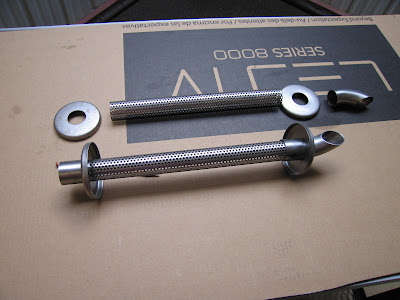
After looking all around at motorcycles, ATVs, etc., and not finding anything I could adapt, I decided to try and build a custom muffler. The components took months to track down, and lots of trial and error, but I finally found all the parts. Below is a photo of the pieces. The 1 1/4" x 12" perforated baffle is from a motorcycle custom shop. The tubing is from Great Plains. The end plates were the most difficult thing to find since nothing from a motorcycle or car (that I could find) was the right size or weight. These are 3 1/4" diameter 18ga stamped flanges from a pool railing supply that are designed to cover the base of a pool railing support. Perfect size and weight. The canister will be a rolled piece of stainless steel or a carbon fiber tube. It will be packed with special fiberglass batting.
The single pipe design meant that I needed to make a new exhaust system with a 2-into-1 collector and a slip-joint. Below is the jig used to help locate the exhaust tubing on the left side -- and the right side pipes and collector ready for tack-welding.
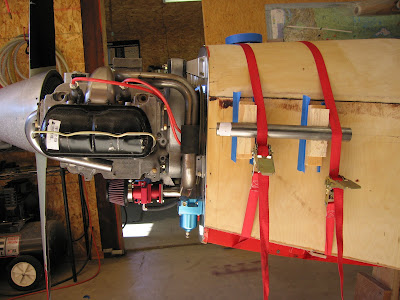
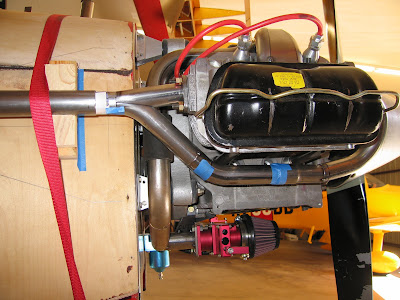
And finally the pipes and muffler parts test-fit in place. There will be a motorcycle-style muffler support strap supporting the muffler through rubber isolation -- on the fuselage.
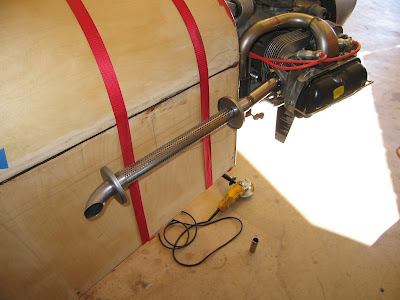
I'll post pics of the completed muffler(s) when the canisters are finalized. Each muffler should weigh about 2 pounds.
Now on to covering the fuselage. I didn't want to be doing all this fabrication on the finished fuse.
--------------------
Posted by Donald on Tuesday, July 6, 2010 @ 02:36 AM:
Looks a very interesting mod and I'm sure many will want to hear how effective it is. Will you ground run the engine or do we have to wait until the aircraft flies?
I've wondered about this sort of thing myself but am too lazy to even begin. One thing I've always wondered about a closed muffler is if the thing gets heavier over time with an accumulation of carbon/lead ash/condensed oil mist etc.. Do you have any thoughts on that? Will your be able to open your's for cleaning out?
Donald
Posted by dannparks on Tuesday, July 6, 2010 @ 10:48 AM:
The engine will be ground-tested extensively, so we'll have some idea how effective it is, but that probably won't happen till early next year.
Most motorcycle mufflers of this type are assembled with screws or rivets so they can be taken apart and repacked -- and I've designed this the same way. I don't know how much buildup will happen. I'll be using 100LL and that could have different results than typical unleaded gas used with mufflers of this design.
Maybe there are some motorcycle drivers in the forum that have some experience with this.
--------------------
Posted by Jorgen on Tuesday, July 6, 2010 @ 04:36 PM:
Dann,
that looks really nice! I don't think the buildup will be a substantial problem, but I'd put some thought into fatigue prevention. We discussed cracks in the exhausts in the original exhausts in another thread, which occurs with irritating regularity it would seem. As I understand you'll get a really neat lightweight design, but maybe slightly longer than the original. That would increase the leverarm of fatiguevibrations, or maybe it is more a temperature fatigue problem? Anyway, a 2-1 system might prevent some of that if the pipes share the loads.
Cool, keep us posted as you go!
May the 4's be with you/ Jörgen
Posted by Bob Grimstead on Monday, August 9, 2010 @ 06:51 AM:
Hi Dann,
Re your lovely-looking mufflers.
You probably know an RF4’s cockpit is pretty noisy, even with earplugs, helmet and ANR kit, so this muffler might be a very good idea.
And one of our recurring problems is cracking at the weld of the rear pipe’s flange. It never seems to affect the front one, so I guess it’s probably a resonance thing. If you look at my post on tuned exhausts, you’ll see that the front pipes are very close to optimum length (if I’ve got my calculations correct). That might be a coincidence, but Rene’s no fool!
The main issue is weight, which is paramount in such light aeroplanes.
I’ll wait and see how heavy these are, and how they stand up to 100 hours of VW vibrations before copying them, but I remain very interested.
Yours, Bob
Posted by dannparks on Wednesday, August 18, 2010 @ 10:47 AM:
The muffler will be supported on the fuselage with a motorcycle-style strap system. This should eliminate the weight and vibration on the pipes that might be the cause of the cracking -- but still allow flexibility. We'll see. Progress is very slow at the moment.
--------------------
Posted by dannparks on Friday, March 11, 2011 @ 07:39 PM:
Just finished building the cans. The're high-temp carbon fiber pre-preg tubes from a shop that makes exotic sailboat spars. I had the ends chrome plated for a bit of bling. They'll be packed with a thin layer of stainless steel wool, stainless steel screen, and fiberglass batting. Total weight 2 lbs. each. They'll be supported on the side of the plane with a strap like motorcycle.
Whether they will work or not is another story. Won't know that till the fuse is painted, engine mounted, and started up.

--------------------
Posted by Jorgen on Wednesday, March 16, 2011 @ 06:18 PM:
Hi Dan,
that looks really cool! I follow your work closely as I think there is a lot of room for improvment on reducing noise om the RF 4, something that in a near future will probably be just as inportant for the environment as for the pilot. I think we will face less public patience with sound pollution in the future, and I think most Fournieteers would enjoy less noise. After all, we fly (motor-)GLIDERS!
Have you made your mufflers something like this?
http://auto.howstuffworks.com/muffler5.htm
May the 4´s be with you/ Jörgen

