| Author |
Messages |
dannparks
Unregistered

|
      
 Posted Thursday, July 9, 2009 @ 07:28 PM Posted Thursday, July 9, 2009 @ 07:28 PM
So, I have started the process of removing the old cotton fabric from the HS, VS, and (eventually) the fuselage. What a mess!
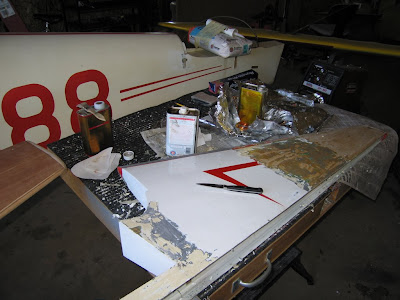
Jasco stripper seems to be the only thing that works. Removes paint, but doesn't harm the wood.
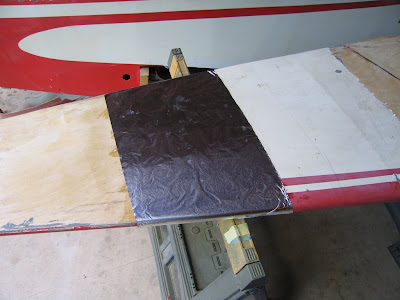
It works well to lay it on thick and cover it with foil for 15 to 20 minutes to let the magic work. Then the next layer or two and be scrapped off. It usually took 3 applications to get it all off down to bare wood.
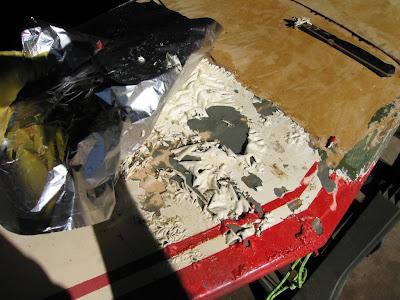
Sometimes the pieces come off in large chunks, sometimes it's 1/4" at a time.
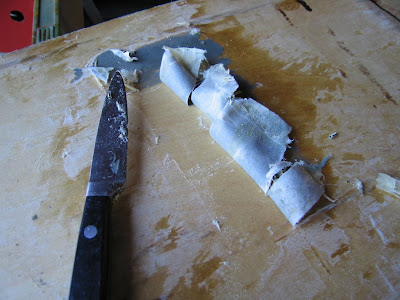
The wood looks nice when it is all cleaned up and all the glue and varnish is removed. The VS and HS were a lot of work. I can't imagine what the fuselage is going to be like.
The dacron fabric on the control surfaces and the wing peals off fairly easy without a lot of chemicals.
I plan to recover the plywood components using fiberglass as Eugenio has described.
A question for Eugenio: when you apply the fiberglass to the VS and HS, do you wrap it around the edges of the thin plywood on the trailing edge of the HS and VS, or do you just trim it to the edge of the plywood and not wrap it?
--------------------
|
Jorgen
Unregistered
|
Posted Friday, July 10, 2009 @ 02:43 AM
Hi Dann,
good going, thanks for sharing. I would be interested to hear what Eugenio thinks too. My limited experience from surfboardbuilding is that fibreglass tends to "curve" around sharp edges, at least unless you use vacuum molding techniques.
On all 4´s/ Jörgen
|
eugenio
Unregistered
|
Posted Friday, July 10, 2009 @ 04:30 AM
I do not know what you mean for HS and VS, in any case I only recover the leading edge plywood up to the uncovered part of the wing surface (the D box up to the spar). It can be done with a one piece fabric so you do only two joints near the fuselage and in the lower middle wing where thew plywood goes up to the trailing edge. Or if you cover first the lower then the upper of the wing you can do the joint just below the leading edge so you don't see it. You should also put a heavier layer of fiberglass below the wing walk (just a precaution). No need to recover the trailing edge since it will be covered by the dacron.
When you are done, lightly sand the surface to get it dull, that's all with the fiberglass.
Next brush some coats of diluited nitrate cement (glue) for 10 cm/4 in over the fiberglass-plywood where you will glue the fabric, so as all over the ribs and the trailing edge, until you reach a gloss finish. When you reach that condition you're ready to cover with the dacron. Obviously before all that you should have done all checks and overhaul of internal fittings and controls, and possibly painted the wing's inside with spar varnish (fancy name of enamel used on boats and windows).
Fabric is glued first in the bottom wing and trimmed at the trailing edge without wrap. No rib stitching is needed. Glue the grommets from the inside so you will have a smooth outer surface. Remember to put the grommets also in the airbrake box, this is of primary importance because is the place who collects more water. after having glued all (contour and ribs) tighten the fabric and put on two or three coats of diluited cement.
Cover the trailing edge with some coats of glue until it become gloss in order to glue the top wing fabric. Now you are ready for the covering of the wing's top. The same procedure, but you won't trim at the trailing edge but wrap it up to cover the whole lower part of the t.e.
When you are finished you can use the finish you are used to, I personally put on some three or four more coats of diluited nitrate cement, then one coat of plasticized 2K sealer primer and two coats of plasticized polyurethanic enamel. One tip for the wing walk: do not use strange and expensive compounds or seld adhesive strips, just mask the part to be done, put one very heavy coat of the same enamel you use for the coloured strips, throw some sand (any kind of sand, but not powder) over the paint, blow away the excess then spray on one or two more coats of enamel, (imediately, the covering coat must incapsulate the sand with the lower coat) you will obtain a wing walk with the same colour of the trimming lines, it won't come off and is quite cheap.
Hope you don't get asleep reading all that stuff
take care
Eugenio
|
jb92563
Unregistered
|
Posted Friday, July 10, 2009 @ 11:29 AM
Dan, will you be using Poly Fiber system to cover the other parts?
I have used it before and you can use the Aerothane paints to get a gloss finish if desired.
The cotton & dope system sounds like a lot more work.
Ray
|
Jorgen
Unregistered
|
Posted Friday, July 10, 2009 @ 01:45 PM
Mille Grazie Eugenio, penso che HS= horisontal stabilizer, VS= vertical stabilizer. I due in sieme= tailfeathers.
Ray, I think you´re forgetting a couple of things; first, if you would describe the same procedure for Poly Fiber, Stitts, Randolph or any other system in as much detail as Eugenio just did it would result in just as much text. Second and more importantly- what Eugenio has described is a way of covering Fourniers that has been tried and tested on a number of Fourniers, which is not true of all systems.
But many inventions are in fact reinventions, and maybe someone will invent a square wheel that works 
On all 4´s/ Jörgen
[Edit by Jorgen on Friday, July 10, 2009 @ 01:48 PM]
|
eugenio
Unregistered
|
Posted Friday, July 10, 2009 @ 02:34 PM
Hey guys, keep calm!
What I mainly described is the way to cover the plywood, that is just a little change from lightweight cotton covering used some 40 years ago. The process of covering the remaining parts of the wing is more or less the same, each kind of brand you use. I personally use Diatex 1500EV, that is produced in France and is certified for the process, but all other US brand are the same thing. And the processes are nearly the same, just change the name of the products, but at last we are talking about the same things. Now I also started to do my own glue with Cellulose nitrate , acetone and plasticizer, that at last is the same thing you call nitrare cement with each own brand name. And if someone is used to follow a particular process it's right he does like so. If you look at Sam's RF4 it's a really fine finish, and he used nitrate dope (or butyrate, that is nearly the same thing less flammable) not a Polyurethane like me.
The only tips I wish to give to everybody is that covering the whole D-box with synthetic fibre (dacron, polyfiber, diatex etc) has a detrimental effect on plywood, because the fabric does not stick to the whole surface like does with cotton, and since the fabric is more elastic than the plywood in some places it can unstick. You don't see that, but the moisture find its way to go there and rotten the plywood, that's why I cover the plywood with fiberglass.
I did an overhaul of a Robin DR400 (for those who don't know it it's like a Jodel) who share the same construction techniques of the fourniers, well the fabric was in perfect shape (we had to remove it to make ad AD on the spar) but when we removed it it was all rotted because the water was trapped between the fabric and the wood.
Enjoy with these messy jobs
Eugenio
|
dannparks
Unregistered
|
Posted Saturday, July 11, 2009 @ 12:21 PM
Great information, Guys. My first question was really about wrapping the fiberglass. The trailing edge of the horizontal stabilizer (HS) and vertical stabilizer (VS) is a thin single skin of plywood -- one on each side of the plywood structure. As Jorgen mentioned, fiberglass does not like to wrap 180 degrees around a thin object like that. It usually bulges out and makes a rounded edge with air trapped below the bulge. Dacron cloth can bend easier and the adhesives hold it tight.
A solution would be just to trim the fiberglass to the edge of the plywood skin and not try to wrap it around, but this might not provide the required protection and moisture resistance as the edge of the plywood skin would only be protected by resin and paint. The old cotton cloth is wrapped.
I noticed that the lightweight 1.45 oz./sq. yd. fiberglass "deck cloth" I plan to use is much more flexible and might be able to make the wrap around, but I would rather not try to wrap it if it is not necessary. Maybe a test is in order.
I plan to use Polyfiber for the fabric components, and will probably paint it all with Polyurethane since I have some that I did not use for the RV6A. The Polyfiber Polytone paint does not work well on fiberglass and since all the plywood will be covered in fiberglass, and there are so many other fiberglass parts, it almost becomes a fiberglass plane as far as painting is concerned. I think I will use the lightweight uncertified fabric for the control surfaces, but I might use the medium-weight fabric for the wing.
--------------------
|
|

