|
|
 |
|
|
|
| Author |
Messages |
SteveBeaver
Unregistered

|
      
 Posted Saturday, May 19, 2007 @ 05:39 PM Posted Saturday, May 19, 2007 @ 05:39 PM
My engine runs smoothly and strongly and starts very easily (at least when it is not very cold) but it runs very rich. On advancing the throttle to taxi I see several puffs of black smoke and even after a long flight at high power, the spark plugs are black and sooty.
I think installing a K&N filter might be a good first step, but I was wondering if there are other common solutions. - Does the Zenith have a mixture adjustment? I have always used 87 octane mogas.
Steve
|
Bob Grimstead
Unregistered
|
Posted Saturday, May 19, 2007 @ 11:44 PM
Hi Steve,
If the engine runs rich all the time, it could be that your float is set too high (or low, I can't remember which) -- allowing too much fuel into the carburettor or your needle valve is worn, or has a tiny bit of dirt on its face. You will see thin black smoke in flight too. Get somebody to stand behind you at your lift-off point and watch you climbing away. If you are leaving a thin trail of smoke, you are running too rich.
For an air filter, I use the foot of a lady's stocking (pantyhose), held in place with a cable tie. It's not such a good filter as the original, but it's smaller, lighter, maintenance free and keeps out the rocks. It is only a Volkswagen, after all.
Yours, Bob
|
Collin
Unregistered
|
Posted Sunday, May 20, 2007 @ 00:53 AM
Hi,
I agree with Bob, Look at the float. A friend with Scheibe motorglider with the same Zenith carb. he had a sunk float.
If can't find a K&n Filter I can send you one when I get back.
Collin
--------------------
|
SteveBeaver
Unregistered
|
Posted Sunday, May 20, 2007 @ 08:38 AM
Thank you Bob & Collin. I will do exactly that.
Is there any documentation available for the carb?
|
Collin
Unregistered
|
Posted Sunday, May 20, 2007 @ 09:19 AM
Hi,
Here is a link to some manuals.
http://www.cfiamerica.com/pdf.htm
http://www.cfiamerica.com/images/Zenith%2028%20RXZ.pdf
Collin
|
SteveBeaver
Unregistered
|
Posted Sunday, May 20, 2007 @ 10:10 AM
Perfect! - I didn't realize these were on the website. Thank you.
Have a wonderful time in Gap. Can't wait to see the pictures.
Steve
|
SteveBeaver
Unregistered
|
Posted Sunday, May 20, 2007 @ 10:17 AM
There are several instructions to "adjust the float level" but no obvious advice on how to do that. Is there a fuel level mark inside the float bowl or some other method of finding hte correct level?
Steve
|
SteveBeaver
Unregistered
|
Posted Sunday, May 20, 2007 @ 04:12 PM
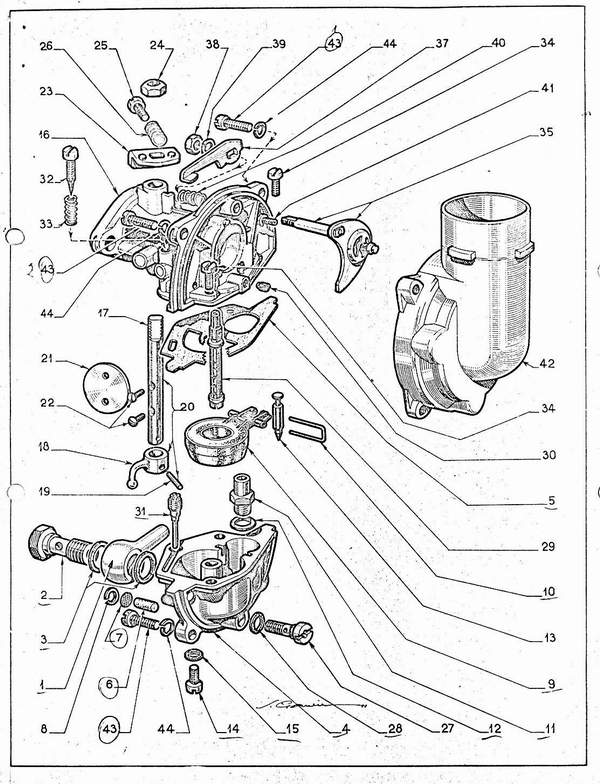
Took it apart today and all looks fine inside. The float and valve seem to be working nicely and the fuel level does not seem out of the place. I took the main jet (Item 29 in the Zenith manual drawing) out though and it looks huge. Measuring the inside diameter of the jet at the end where it just barely pokes into the venturi, it measure 3.5mm ID. It has "5" stamped into the side. I will compare it to the jets on Joe Foley's airplanes sometime this week to see what they have.
Colin, If Eugenio has an extra set of Zenith gaskets at Gap, would you get me one please?
Thanks,
Steve
|
Collin
Unregistered
|
Posted Monday, May 21, 2007 @ 08:54 AM
Hi Steve,
I will bring back some gaskets and try to bring some extras.
When I rebuilt the carb. when Jerry still owned N2182. It was running rich. It was missing the gasket (#12 Alum. washer) under the seat for the float needle (#11).
Just a note on the carb. parts
#27 main jet
#31 idle jet
#30 air corection jet
|
SteveBeaver
Unregistered
|
Posted Monday, May 21, 2007 @ 09:25 AM
Thanks Collin. Seems l assumed the vertical, perforated pipe that ran up to the venturi was the main jet. I'll check for that washer.
Steve
|
Collin
Unregistered
|
Posted Friday, June 1, 2007 @ 12:43 PM
Hello,
I am bringing back 5 gaskets for the Zenith carbs they were gifts from CFI-Germany. If any one needs some drop me a note.
Collin
|
Bob Grimstead
Unregistered
|
Posted Friday, December 26, 2008 @ 11:26 AM
Hi Folks,
Sorry to re-visit an old topic, but did anybody figure out from the French and German in the Zenith publication, how to measure the correct fuel level in the float bowl?
I've taken the carburettor off WGN and put it on to HDO, and there is a marked performance shortfall.
The jets are all correct and there is plenty of fuel flow. There does not seem to be very much leakage around the throttle butterfly or anywhere else, but I'm not sure of the float level.
I gather you add or subtract aluminium washers from under the needle valve, but what should this achieve?
A fuel level at the top of the float bowl, or somewhere below that level?
Any help gratefully received.
Yours, Bob
|
Bob Grimstead
Unregistered
|
Posted Saturday, January 10, 2009 @ 02:59 AM
Hi Guys,
Eugenio very kindly e-mailed this advice to me:
Enclosed copy of the leaflet of Zenith 28RXZ carb. Fuel level should be (as per leaflet) 9 mm below the sealing surface. Adding spacers under the needle valve seat lower the fuel level, removing the spacers raise the fuel level
into the bowl.
In any case you should check not to have problems in take-off / climb attitude, in this case you must raise the level.
Just an advice: after the level setting take great care in checking the performance, there is the possibility that the level is slightly low.
Some considerations:
1) Too low level can lead to a lean mixture and can be dangerous in take off/climb attitude
2) Too high level can lead to a rich mixture with all the problems you know plus fuel leakage from the carb vent or any other passage the fuel can find.
On the leaflet you can find also all jet settings. The needle valve seat (not included in the list) is 2.5 mm for the Rectimo without fuel pump and 1.5 for engines with fuel pump. This just for a fuel flow rate, not for other purposes.
ciao, Eugenio
|
cooperman
Unregistered
|
Posted Saturday, January 10, 2009 @ 06:43 AM
Happy New Year Bob
I will be dropping the carb off 'LN soon to sort my rich running. I have the Zenith stuff but in French and German - do you have a translated version?
Rgds
Paul.
|
Bob Grimstead
Unregistered
|
Posted Sunday, January 11, 2009 @ 09:09 PM
Hi Paul,
Happy New Year.
Eugenio has sent me a 'translated' (by computer) English version to edit and correct, but it's almost incomprehensible.
Give me a couple of days, and I should have something comprehensible.
We shall then post that so everybody can overhaul these carburettors.
Yours, Bob
|
Donald
Unregistered
|
Posted Monday, July 27, 2009 @ 04:45 PM
I have just begun to see this in my RF3. It was always the case that if I climbed to 9,000 or 10,000ft the exhaust would get smoky enough to see but that is evidently due to altitude and the lack of a mixture control on the Zenith. Now, though, I have begun to see it at much lower altitudes but only at full throttle. Also the engine sounds like it's misfiring a little but if I back off on the throttle it smoothes out and it's OK. So I had the carb off at the weekend, stripped to it's component parts and blew through all the jets and orifices with 'Carb Cleaner'. Better, but no cigar.
Pulled the plugs and they were very black and sooty so swapped them for new and again saw an improvement, though mainly on idle, but it's still not quite on song. Not sure what else to try, although perhaps Eugenio's remarks in another post about modern unleaded mogas might be worth pursuing. The downside of that is the eye-watering cost of avgas in the UK not to mention the lead ash deposits in the engine and exhausts.
Any insights would be gratefully received.
Finally, in the data sheet on the Zenith in the downloads section, at the end under 'Miscellaneous Data', are the numbers against the jets etc, diameters?
|
Bob Grimstead
Unregistered
|
Posted Saturday, August 1, 2009 @ 09:23 AM
Hi Donald,
First thing, check tat your air filter is clean. A dirty filter can make you run very rich. If the sponge is collapsed, it will be worse.
Then check your float level, according to the manual.
The correct main jet for the gravity-fed 1200 Rectimo is 1.25, that's 1.25mm diameter.
We are runnning 1400 motors (83mm pistons etc) on ours, and have found we get best results with a 1.29mm main jet.
BUT that does not mean running 1.29 drill bit through it.
f you measure precision drill bits, they are all about .01mm undersize, but they all still drill an over-size hole.
You will need selection of bits, from 1.25, 1.26 etc to 1.30, plus a micrometer to get this right.
I ended up with 1.28mm hole, and very gently ran a 1.28mm bit through it with my fingers, to get a 1.29mm (exact) hole.
That works with OUR carb, OUR (incorrect) float setting, on OUR motors, and we now get 600+ feet per minute climb.
Also, check your throttle butterfly is fully open when your throttle knob is fully forward.
Good luck.
Yours, Bob
|
Donald
Unregistered
|
Posted Sunday, August 2, 2009 @ 07:29 AM
Thanks Bob.
This change has happened very recently for me and the the usual suspects you mention were the very first to be checked out. Actually, since it was running rich my first suspicion was that the air bleed to the emulsion tube had got partially blocked. It hadn't. Nor has my float chamber level been changed and it appears to be around the book figure of 9mm.
Just looking into the venturi I'd say that my butterfly does not align absolutely parallel to the airflow at full throttle, but remains a degree or two shy of that. Given my earlier remark about the improvement from slightly closing the throttle I'm not sure what the effect of that might be but I'll look at it again next time I'm at the hangar.
My engine is also 1400cc and the number stamped on the main jet is 125. I have another main jet from another 28RXZ that's stamped 120 and although I have not flown that jet, full throttle ground runs don't appear very much different. I would be reluctant to put a drill bit through my main jet since it seems to me that could only exacerbate the situation. If anything I would be more inclined to solder the main jet shut and run a smaller drill bit through it but I'm not about to do that either. I'm not even sure how I would go about measuring the bore of a hole that small, though I daresay there is an instrument that will do it. Not a normal micrometer, though.
|
Bob Grimstead
Unregistered
|
Posted Tuesday, August 4, 2009 @ 07:58 AM
Hi Donald,
I measured my jets by buying ten drill bits, 1.20 to 1.30 (or was that 11?), then seeing which would fit (shank ends), and then measuring them in a micrometer. The bits all seemed to be .01mm undersize (sensible, since they usually drill holes slightly bigger than the bit's diameter).
If your butterfly is not absolutely aligned with the venturi at full throttle it will make very little difference. Even 30 degrees offset seems to make little difference. As you will know, the power reduction on pulling back your throttle plunger even half-way is not much.
I'm stumped on you over-rich mixture. I don't suppose anything (fluff, feathers, filter debris? could have been sucked into your manifold?
Yours, Bob
|
Donald
Unregistered
|
Posted Tuesday, August 4, 2009 @ 02:46 PM
Hi Bob,
Your use of drill bits to gauge the jet is pretty much how I figured it must be done, though I imagine I could probably buy a device a little like a feeler gauge but consisting of graded wires rather than flat blades.
I hadn't thought of contaminants in the manifold. The only comment I'd make without investigation is that all 4 plugs are pretty evenly sooty and I think I'd kind of expect an obstruction to be on one side only. Certainly with the carb off there's no indication that the manifold is anything other than clean.
Eugenio is fairly damning of modern mogas, which I have been using, so in the absence of anything else obvious I think I will make a trial flight with avgas and see if anything changes. I hate the lead ash build up you get with that stuff, though. I pine for the old leaded 4 star mogas. Even smelled nicer.
Thanks again and I'll report back with my findings.
Donald
|
eugenio
Unregistered
|
Posted Wednesday, August 5, 2009 @ 11:20 AM
Sooty plugs are normal with unleaded rubbish, but they works fine the same. We run usually with 95 mogas and we have absolutely no problems. With all our VW, no matter the brand name, and up to the L2000 with 8.5:1 CR.
We only use avgas on long trips thru europe (France and England) because it's easier to find it on the airports, otherwise we use any kind of mogas.
Think this......... do you make all these problems with your car? (I should say your buggy) NO, so why make problems with the same engine installed on a motorglider?
cheers
Eugenio
|
JamesB
Unregistered
|
Posted Thursday, August 6, 2009 @ 09:58 AM
Regarding float levels: A rebuilding kit for the 150CD carburetor noted that to set the floats, take off the bottom fuel bowl, turn the carb upside down and measure from the bottom of the floats to the edge of the casting. That distance should be 15mm.
When I was on my trip & the carb was running rich, I removed the float bowl with the carb still on the engine & gently pushed the floats into place, then measured as best I could (given the position of everything). I tried as lean as about 23mm -- and that seemed to make the engine stumble on take-off. I tried 19mm which overall, seemed to work out better. One book seemed to suggest that the floats should only be moved about 1mm at a time -- checking the results each time.
Important: As Steve suggested, the mixture will be affected by airflow. I have a non-standard air filter (just a layer of foam over the carburetor air box). If that filter is restricting airflow, that would tend to richen the mixture. I'm searching for a more standard filter element or a K&N insert. Once I get a more standard airfilter, I'll have a better sense of whether my float adjustments are appropriate.
|
Collin
Unregistered
|
Posted Thursday, August 6, 2009 @ 02:55 PM
re: Zenith 28
If the needle seat washer (#12) is missing. The engine will run rich.
|
eugenio
Unregistered
|
Posted Friday, August 7, 2009 @ 11:42 AM
In the 150 CD and CD3 to set the float level you have to bend the tongue that push on the needle valve.
150 CD and 150 CD3 settings are different.
For the filter if you have the original Limbach/VW filter you should not use foam but steel wool like the coarse one used to clean saucepans, foam reduce air flow enriching the mixture. You should also take care about the membrane condition and check the carb to filter gasket is in the right position.
Mixture can be regulated by screwing the needle (in the CD3) or the nedle seat (in the CD).
In the 28RXZ the (#12) washer thickness sets the fuel level.
I sent today some washers and gaskets for 28RXZ and 150CD to Collin, so if anyone in the US need someting can contact him.
Eugenio
|
Donald
Unregistered
|
Posted Saturday, August 8, 2009 @ 03:24 AM
My use of mogas or avgas has been pretty much the same as Eugenio's. Mostly mogas, but I take avgas when I fly in to a field where it's on site.
My carb has the #12 washer, the same one that has been in there all the time I've owned the aircraft. It's not a blocked air filter for I see the same thing with no filter.
The float operated valve is fine for if it doesn't seat I get a pool of fuel on the hangar floor. (Saw that once after maintenance.)
I'm pretty familiar with my carb and I can see nothing wrong, but they are subtle devices. The only components I've never understood are items 6, 7 an 8 on the illustration Collin posted. Anyone know what they are for?
Eugenio, what replacement parts do you have for the 28RXZ?
Thanks for the replies, guys.
|
eugenio
Unregistered
|
Posted Saturday, August 8, 2009 @ 03:17 PM
6 should be the fuel drain, 8 is a locking washer and 7 maybe a plug.
I have the full set of gaskets, enclosed the fibre and alu washers for main jet, banjo fittings and needle valve seat.
Eugenio
|
Donald
Unregistered
|
Posted Saturday, August 8, 2009 @ 03:40 PM
Eugenio,
I'd like to buy from you a set of gaskets and washers you mention. How do we do this? Shall I email you or what? Clearly I will need to send you payment so have you any preferred method for that?
About items 6, 7 and 8 on the illustration, I thought 14 was the drain plug. On my carb 8 is a split retaining ring and 7 is a wire gauze mesh but as I have never dismantled that I don't know what 6 is or what it's made of. They all fit into a small port that appears to connect the rear of the carburettor disc to the air filter plenum but it has always been a puzzle to me.
Donald
|
eugenio
Unregistered
|
Posted Sunday, August 9, 2009 @ 11:14 AM
The gaskets are sold in complete kit for 10 euros per set. Email directly to me to agree the shipment and payment.
14 is the drain plug for the float bowl, the hole thru the air filter support plenum and the rear of the carb is a vent that drains the fuel sorting out from the filter side of the venturi. The small brass pipe (6) should be connected to a plastic hose taking the fuel off the cowling like the engine breather.
Eugenio
|
Donald
Unregistered
|
Posted Sunday, August 9, 2009 @ 12:16 PM
email sent
|
Bob Grimstead
Unregistered
|
Posted Thursday, August 27, 2009 @ 09:07 AM
Hello again Donald,
I've been mulling over your problem.
Could the main jet or that vertical emulsion tube perhaps have come loose, letting in more fuel?
The only obvious things I can think of are a leaking needle valve (inlet valve to the float chamber, operated by the float) or a leaking float.
Let us know what you find.
Yours, Bob
|
|
|
|
|
|
|
|
|
|
|
|
|
| Login |
|
|
In order to fully utilize the abilities of this board, you are required to register as a member. Registration is free, and allows you to do lots of things including turning on or off certain features of this board. Register now! |
| Forum Rules & Description |
Who Can Read The Forum? Any registered user or guest
Who Can Post New Topics? Any administrator or moderator
Who Can Post Replies? Any administrator or moderator
Who Can Edit Posts? Any original author
|
Discussions on all engine related matters |
| Currently Active Users: 680 |
There are currently 0 members and 680 guests on the boards. | Most users ever online was 42535 on 04-07-2026 02:43 AM
|
| Search This Forum |
|
|
|
|
Powered by CuteCast v2.0 BETA 2
Copyright © 2001-2003 ArtsCore Studios
|
|
