Posted by Collin on Thursday, February 1, 2007 @ 05:35 PM:
Carburator problem on your Rectimo ?
During the last months I noted that several RF3 or RF4 owners claimed facing engine problems with their Rectimo engine , assuming a carburator failure or problem after an engine overhaul.
In two reported cases the engine drop outs started regularly after reaching a certain altitude this means when the engine was really warm.
This kind of problem was also faced by Franz, a new CFI Member in South Germany with his RF4D with a Rectimo/Zenith carburator.
In March 2004 Franz got an engine stoppage in the Austrian Alps but he was high enough to glide to the next airfield.....15 km away !
He send his Bendix magneto to a famous German repair station, specialised in Magneto repairs. The inspection/repair cost 650 euro ( 850 us dollar !)
But the engine still did not work properly after the expensive treatment and regularly started misfiring after the oil reached 100 °C.
The Bendix magneto was then inspected a second time by another certified repair station based on his home airfield. A failure could not be found and the magneto fired properly on the bench.
Consequently Franz deducted that his problem could only come from his Zenith carburator.
2 years long Franz experimented on his carb without success.
He installed another Bendix magneto but this did not solve the problem.
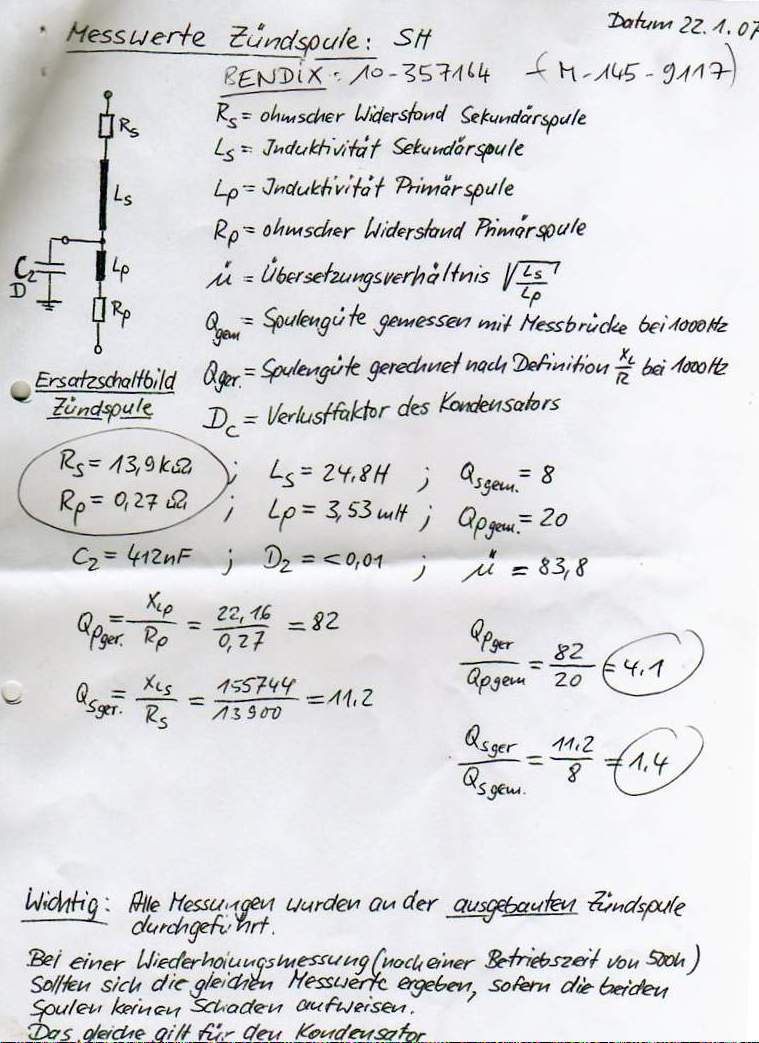
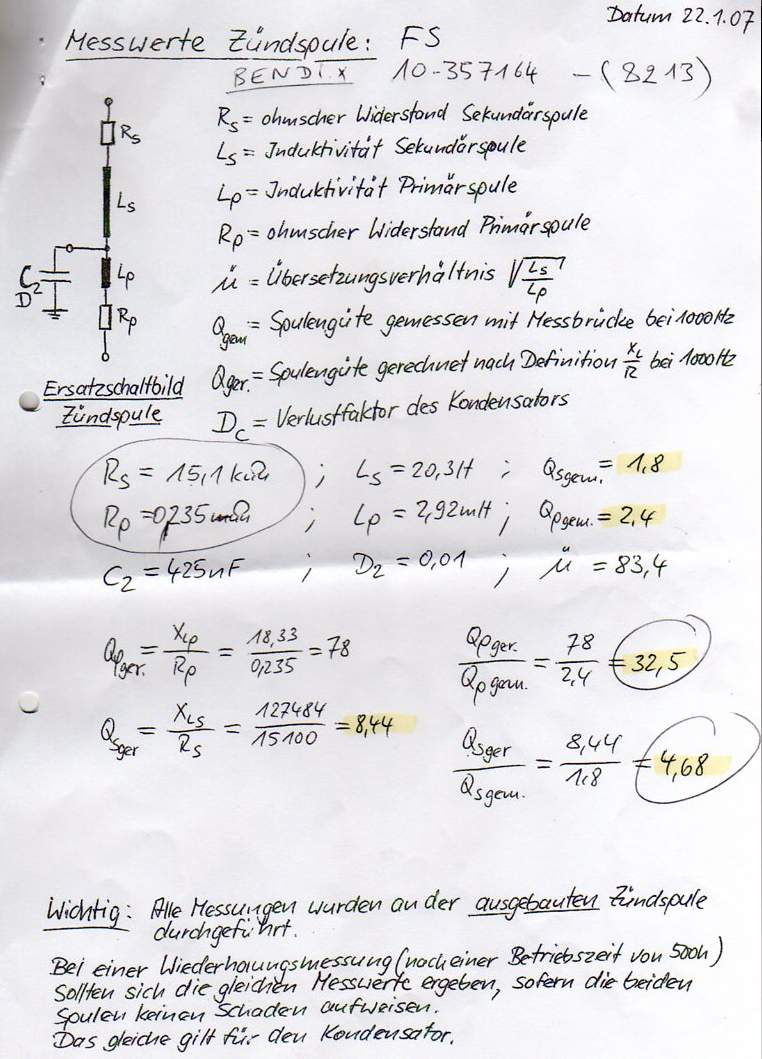
Finally Franz asked for help in the CFI Web site forum and became a few days later a new member. He send us the 2 Bendix magnetos which we handed over to a friend, Walter, a true expert in electrical matters. And what Walter found out in his private lab was most interesting: In both magnetos the ignition coils evidenced primary and secondary resistance values full within the specs given by Bendix in the maintenance documentation. And this is what Bendix ask to do in order to check a coil, not more.
But, and this is the point, the Q-factors of the coils measured with an induction bridge, revealed that the induction values were completely out of specs, (specs which are not mentionned in the maintenance manuals).
Result: the coils were found servicable according to the measured Ohm values but were in fact out internally damaged and dangerous. The certified station issued the release certifcate Form one including a 3 pages maintenance report !!!
Interesting is the fact that the spark lenght, this means the final high tension test on the bench could not evidence a problem at normal temperature. The problem arose only at high engine temperature of 100°C.
This story might be interesting for RF owners who are trying to fix their carburator
Maybe a new 100 us dollar coil will be the solution !!! But be carefull and do not try ot open a Bendix Magneto if you are not trained for that job. For sure you will not be able to close it again and have it functionning after !
enclosed the measure reports of 2 Bendix coils.
the coil named FS was the bad coil of Franz.
the coil named SH as a comparison is a coil in good condition.
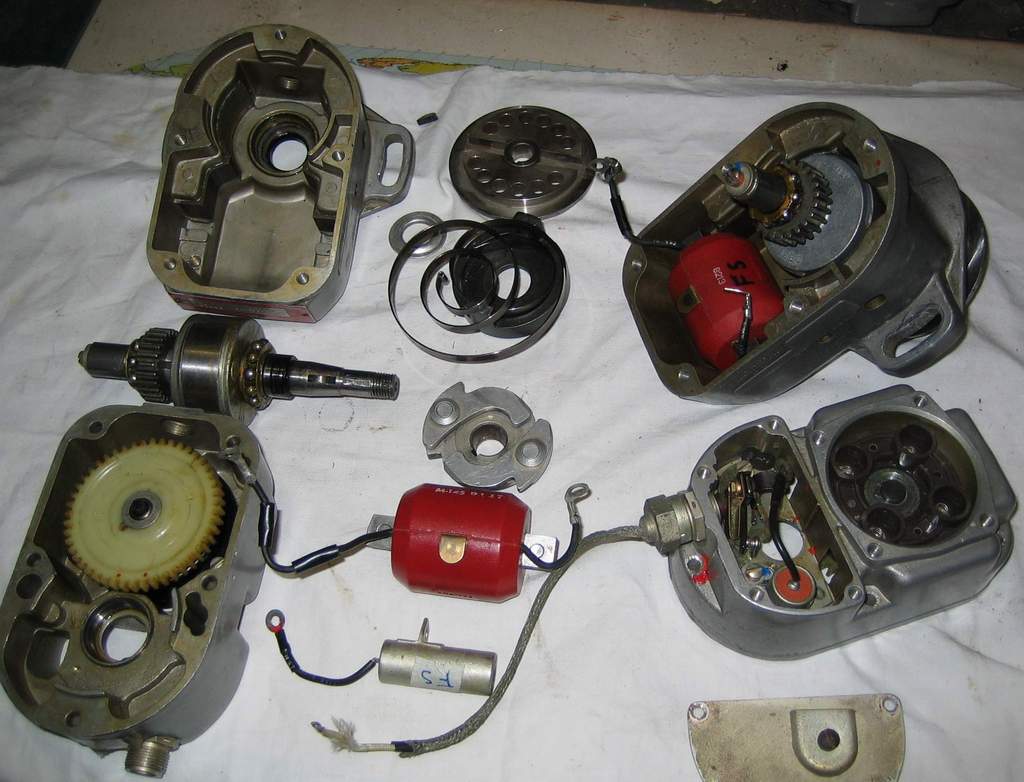
I put of picture of 2 Bendix mangnetos for illustration.
Patrick Faucheron
Posted by Bob Grimstead on Monday, February 5, 2007 @ 03:34 AM:
This is very, very interesting.
Five years ago, my RF4 was owned by a syndicate, and they had precisely the same symptoms on longer flights with higher engine temperatures. They had the magneto investigated by a local expert, and he diagnosed precisely the same problem. He also replaced that coil and fixed the problem. I was given the old coil when I bought the aeroplane. There is no obvious difference in appearance with the new one.
Incidentally, after going to all the trouble of taking out the complete engine to look at the magneto, we discovered the reason for the chamfer in the fiberglass magneto cover that protrudes into the cockpit. It is designed to take the swivelling magneto when you merely undo the upper engine bolts and pivot the engine downwards to access the magneto. Doh!
Much easier than taking the engine right out!!!
Good luck.
Yours, Bob
Posted by patrick on Monday, February 5, 2007 @ 01:57 PM:
To continue the story about magneto failures and diagnostic heren a excellent report dealing exactly with this problem.
Please look at:
http://www.sacskyranch.com/eng174.htm
As a consequence, when you fly on one single mag better have it properkly checked and dont rely on the simple ohm-meter measure .
By the way more and more RF owners install a secondary ignition. and this really makes sense.
Patrick
--------------------
Posted by Donald on Sunday, March 28, 2010 @ 02:30 PM:
I have been having problems with my engine which I assumed to be carburettor related. But it's such a simple carburettor and I've been through it, cleaning it, making sure the float level is correct and trying new main jets with different orifices, all to no avail. So on the way home from the hangar this evening I began to wonder if instead maybe the magneto timing had gone wildly wrong thus preventing incomplete combustion, and as I thought about that something I had read crept from my memory. This was that read faintly remembered.
So, the timing and the magneto are next for investigation. Timing I can check myself but I do take Collin's caution very seriously about dismantling a magneto not being a DIY job.
I'll post again when I have something to report.
Donald
Posted by Bob Grimstead on Monday, March 29, 2010 @ 09:01 AM:
Hi Guys,
My Australian Fournier's new Aeropower engine has dual ignition.
The secondary ignition source is electronic, using a Hall effect sensor that slips into the old distributor drive, plus a couple of coils on the firewall.
Mike Munninger, my VW expert here in Australia, is currently drilling a pair of heads and making a siimilar system for my English aeroplane.
Yes, The RF4 was certified in Europe on the basis of 'equivalent safety' with a claimed glide angle of 20 to one.
This was partly because, in the late 60s, nobody knew how to organise a proper secondary igniton system.
In reality it only glides at 16 to one, and there's nothing like a little extra security when you're flying low-level aerobatics over European city centres, so WGN's getting secondary ignition too.
That's just me, you can all make your own decisions.
Yours, Bob
Posted by Donald on Monday, April 5, 2010 @ 12:29 PM:
OK, I now have my magneto off the engine. The data plate tells me its a Bendix type S4RN-21, part number 10-51360-28.
After taking the engine off the firewall but before attempting to open it or remove it from the engine I thought I'd see if I could find any technical info on this device. Aeronca.com turned up trumps with the manual scans here: http://www.aeronca.com/manuals/BendixScintilla/index.asp
Donald
Posted by Donald on Sunday, April 11, 2010 @ 04:50 AM:
My Bendix has been overhauled and is on its way back to me with, amongst other parts, a new coil. I'm not sure they tested the coil as described by Patrick in the thread opener, but the overhaul company told me the coil was so old and such poor condition they changed it anyway. Nice thing was they they didn't charge extra to the overhaul price they quoted before they saw it and I think the coil costs around $100. £85.00 in this country.
Next weekend I will be working at putting everything back together and I'll post how it goes.
Donald
Posted by cooperman on Monday, April 12, 2010 @ 03:02 PM:
Donald
Following your previous postings and this thread it sounds like I am suffering similar problems to yourself?
I have noticed a slight missfiring at full power and the rpm them drops back 2-300 rpm and runs a little roughly. If I back the throttle off slightly the engine runs fine and the rpm is maintained at its peak.
Although I havn't had chance to check a few other things (induction, choke etc) I wondered if your returned magneto had sorted your problems yet?
Regards
Paul
Posted by Donald on Tuesday, April 13, 2010 @ 02:33 AM:
Paul,
I can't tell you yet. My magneto should be at my home by now but I'm not, so it will be the weekend before I get the chance to put it all back togeteher. Then I'll find out and I'll post my results.
But your symtoms sound those I began to see last year. It occurred first when flying but it had got worse over the winter and by this spring I could replicate it on the ground but only after the engine had had a chance to warm up some. Last time I flew her, climb was very much reduced and it was an uneasy excursion.
Does your exhaust become visible when it goes rough?
Regards
Donald
Posted by Donald on Monday, May 3, 2010 @ 03:39 AM:
mmm. This is not yet solved for me.
Having my magneto overhauled has certainly been beneficial, the engine idles much more regularly where it used to 'hunt' a little, I'm getting about 150 more static rpm, climb performance is up by approximately 100fpm and it runs much more smoothly in the air, but it's still running rich.
There is residue around the muffler perforations that is sooty, not oily, plus the smokiness is black, not grey. Also, the airframe is not picking up oil spots, which I have seen in the past when my piston ring gaps lined up letting oil escape past the piston, so I don't think this is burning oil, I think its excess fuel. I just cannot figure out why it's happening.
My carb float bowl level was bang on the 9mm book figure but I've lowered it a little, by less than half a millimeter, to try that. Also, I'm running on a slightly smaller main jet than before.
Posted by Bob Grimstead on Monday, May 3, 2010 @ 08:40 AM:
Hello again Donald,
I can't remember whether you're running a 1400cc engine, but I think you are.
I'm not sure if I've mentioned it somewhere here, but we found that a main jet around 1.28mm diameter (meaning a 1.29 drill bit just goes through it) works best at 1,000 feet with the 1400cc motor. Above that of course, it will run rich.
Because I don't want my enigne to get too hot, I tend to run a 1.30 jet most of the time, changing back to a 1.28 for important displays, like the Red Bull thing.
There is actually very little difference in piston crown colour, plug colour or exhaust residue colour between a 1.25 jet and the 1.30 jet. The latter runs just a tiny bit more rich to keep the combustion chambers a little cooler.
Don't know if that helps, but information is power, they say.
Yours, Bob
Posted by Bob Grimstead on Tuesday, May 4, 2010 @ 03:28 AM:
Hi again Donald,
I don't know if you've measured your main jet, but we have four of them, and found that they were all over-size to a greater or lesser extent.
I'm not sure if this is because the fuel flowing through the jets wears them over time, but I have also noticed that most older cars seem to run rich. Both of ours certainly do, and many have not only blackened exhaust pipes, but balck smudgy areas on the rear of the car around the exhaust pipes (not oily, but matt black, indicative of excess richness).
I would offer to lend you some 1.25 to 1.30 drill bits, but by the time I've got your address and mailed them from here in Australia, it would probably be quicker and cheaper for you to buy them.
If you have not measured your main jet, or if you have and it has turned out to be over-size, I would suggest you heat up the jet with your soldering iron and when it's good and hot, drop a bit of solder into the hole, and then drill it out again carfeully with a 1.25mm bit if you have a 1200cc motor, or a 1.28mm jet if you have a 1400cc motor. You can get a 1.25 or 1.28mm bit from Drill Service Horley mailed to you overnight. They cost about £1 each plus postage, so not more than £2 altogether I think (but of course ask them to be sure).
Mine have always arrived the following morning (in Britain), even when I phoned at 4:40pm!
Their number is 01293 774911.
I hope this helps.
If your jet is already less than 1.30mm diameter, then sorry, but it's probably not the main jet that is causing you to run rich.
Yours, Bob
Posted by Donald on Tuesday, May 4, 2010 @ 08:23 AM:
Bob,
Thank you for your suggestions and offers of help. I have 3 main jets, the largest is the one that came with the aircraft 13 or 14 years ago, but I have two new ones from Eugenio one of which I'm using just now and which I reckon is 1.3mm bore (the engine is 1400cc). I also have a selection of small drills. However my feeling is that it's not the main jet that's the problem. I kind of feel it might be a float chamber level issue, despite it being on the 9mm book figure, and I am beginning to play with that. If so then it probably makes sense to revert to the larger main jet so that there is sufficient flow into the emulsion tube at climb.
I had contemplated the solder-and-drill option, though I thought about silver solder rather than lead solder, but Eugenio's supply house removed the need...for now.
Full bore richness and rough running may be a throttle stop issue. I have discovered that my butterfly was being driven beyond parallel with the venturi. I don't know if there ever was a full throttle stop screw, I don't remember there ever being one, but I have fitted one now to limit the movement. This makes some sense as backing off a little stopped the rough running without affecting RPM. If this is the case then a recent change of the gasket between carb and manifold may have exacerbated the problem since the new one is thinner than the old.
If Iceland's volcano lets me fly this coming weekend I'll report what, if any, improvements I find.
Donald
Posted by Jorgen on Tuesday, May 4, 2010 @ 01:38 PM:
Godspeed Donald,
I think your correct in your assumption that flying in volcanic ash might not exactly cure carburator problems regardless of eventual legal matters...
May the 3's be with you/ Jörgen
Posted by cooperman on Sunday, May 9, 2010 @ 03:10 PM:
As I am not at the airfield at the moment does anyone know the internal and external diameters of the Zenith needle valve washer?
Thanks
Paul
Posted by Donald on Monday, May 10, 2010 @ 01:35 AM:
9.3mm ID and 12.7mm OD.
Posted by Donald on Saturday, May 22, 2010 @ 04:53 PM:
I promised I'd come back and report progress when I could. I now feel I can.
To recap a little, I began to notice the engine running rich last summer, and when I say I noticed it I mean I could see smoke from the exhaust go past the edges of the canopy. It was black not grey which I think conventionally means unburnt fuel, not burnt oil. So, I began with the carburettor.
I made sure everything was clean, that no jets or airways were blocked and that the float had not sunk. I tried lowering the float chamber level and smaller bore main jets but while everything I tried changed the characteristics they did not solve the problem.
Next I turned my attention to the ignition and this thread persuaded me to have the magneto overhauled. That produced very tangible improvement by way of much smoother idling, higher static rpm and increased climb performance, but I was still seeing smoke and getting rough running at certain throttle settings.
Again I experimented with lowering the float chamber level. Half a millimetre too low and I got terrible surging at full throttle, fortunately during a ground run, so reverted to the book figure. The aircraft flew well like this but was burning too much fuel and was clearly not right.
Along the way I had the induction system apart and reinstalled with new seals and gaskets and took the trouble ensure that the steel upper induction tubes align properly with the cast alloy carb manifold. I replaced the ignition harness and spark plugs and redistributed the piston ring gaps in one cylinder where they had lined up resulting in an oily plug.
Latterly I came to realise that I had made changes to the carb before I focused on the magneto and that some of these changes were still there so, in desperation, I decided to take the carb back to how it was before the trouble began by reinstating the original main jet and float needle valve washer. This last has the effect of raising the float chamber level above the book figure, which seems counter-intuitive to cure rich running, but the logical approach was bust by now. I did that this morning and was encouraged by a clear ground run to airtest the changes which would effectively mean that the only new item in the equation is the overhauled magneto.
In the 14 years I have owned the RF3 I have never known her run so sweetly or so strongly. She idles beautifully hundreds of RPM lower than she previously would. Static RPM is up by about 200 and rate of climb is up by about 12-15%, I still have to do a timed climb so that figure is just taken off the variometer. Her fuel burn is back to around what I used to get. For example just two weeks ago I topped her off with 20 litres after 2hours 10 minutes in the air. Today it was 17 litres after 2 hours 15 minutes. I used to figure on 8 litres per hour.
So I think I'm done and I am now sure that my rich running problem was down to the deteriorating state of the magneto. Why raising the float chamber level would make her run leaner I cannot explain, but as I said in another post, carburettors are subtle devices.
Posted by Bob Grimstead on Saturday, May 22, 2010 @ 10:47 PM:
Hi Donald,
Thank you very much for all that very detailed information.
You attention to details and the step-by-step deductive approach were inevitably frustrating and time-consuming, but the symptoms and information you have provided for all of us are invaluable.
Thank you again.
Yours, Bob
Posted by Donald on Sunday, May 23, 2010 @ 04:35 AM:
Bob, You're welcome. I have benefitted by others sharing their knowledge and experience of keeping our Fourniers in the air, so I'm happy to do my part in return.
One pearl of wisdom I'd give to anyone fiddling with things is this: 'The first rule of tinkering - Keep all the parts.'
Posted by flyingkroeger on Sunday, May 30, 2010 @ 10:54 PM:
Hi Guys,
May I also ask for your advice. My idle rpm has always been a little higher than desirable – around 900-1,000 rpm. Recently I had the engine off to change the old rubber mounts, which had sagged a little.
Unfortunately a lot of things got in the way of aviation and as a result of that the engine has been off for half a year. Un-pickled of course, since I initially anticipated to have the engine off for only a week. Yeah, right…
Last weekend I finally managed to get the engine back on with a LAME friend. It was a miserable cold and wet day and she was reluctant to start. When the engine finally fired, it ran OK, but with a very high idle – 1,600 rpm.
We then checked the setting of the idle adjustment and the throttle valve appears to close completely. Since nothing has changed on the engine apart for the new engine mounts, I am unsure as to what causes the high idle rpm. Any ideas? Could it be a speck of dirt wedged between throttle butterfly and carburettor housing?
For your info, when I bought the RF4D, I had the magneto professionally overhauled, including a new coil. Since the engine ran quite well after that I have not touched the carburettor since.
BR
Tim
Posted by flyingkroeger on Sunday, May 30, 2010 @ 11:02 PM:
Hi again,
Whilst we are on this topic (well, I am…), can I ask another shtoopid question. I have never been able to re-start my hot engine. That’s hand propping, not air start.
Neither the flight manual nor the Rectimo manual contain specific procedures (unless I am blind on top of shtoopid…), so what are your tried and tested methods?
As always, grateful for your advice.
BR
Tim
Posted by Donald on Sunday, May 30, 2010 @ 11:30 PM:
Hi Tim,
When you say it idles at 1,600 rpm do you mean thats what you get with the throttle closed or do you mean that you have to open the throttle and 1,600 rpm is what it takes to get her to idle evenly? If it's the latter then it could be that the idle port is blocked, perhaps with fuel varnish after a long lay off.
I have a couple of pictures here http://sbeaver.com/cgi-bin/fournier/cutecast.pl?session=BJyOp6LSpXnnBr2eHkOF4f8Rn2&forum=13&thread=194 of that port on my carb. I'd suggest trying cleaning the carb using Carb Cleaner, STP make a version but there are others. It contains toluene and is a very potent cleaner, but keep it away from your paintwork.
As to starting a hot engine, mine starts OK without use of the choke. Cold starting goes OK too after use of the choke to prime. Warm staring can be a little more involved but I feel it comes down to either it's too cool not to need priming and I haven't, or it's too warm to need priming and I have. If the latter I open the throttle and blow it out with 4 back blades of the prop. That usually does it.
Posted by flyingkroeger on Monday, May 31, 2010 @ 01:16 AM:
Hi Donald,
Thanks for the reply. What I meant is that the engine idles at 1,600 at closed throttle and (what appears to be) closed butterfly.
BR
Tim
Posted by flyingkroeger on Monday, May 31, 2010 @ 02:54 AM:
Hi again,
I read through the other post and judging from the pictures and the exploded view in the manual I take it that the butterfly valve should be a reasonably tight fit to force the air through the idle gallery with its separate mixture adjustment.
I was able to move the spindle up and down a bit – maybe 1.5 mm. Would this indicate wear? But how can this happen suddenly whilst the engine is not even used?
Maybe I should just remove the carburettor and have it checked/rebuilt by a professional…
BR
Tim
Posted by Donald on Monday, May 31, 2010 @ 08:23 AM:
Tim, I don't think that's how it works. At idle I think the butterfly is not closed tight across the venturi but leaves a small gap for air to pass. There may be another small port in the wall farther forward, closer to the butterfly, fed from the same gallery that supplies the port in my photos.
The idle air bleed screw farther forward again is for fuel/air mixing, much in the same manner as the emulsion tube between the main jet and the venturi, but on a smaller scale. The principal air for combustion is still going past the buterfly, not through the air dilution passageway.
My butterfly can also move vertically when fully open but I would not say it's as much as 1.5mm, maybe 0.5mm but that's a guess.
However, if your engine idles at 1,600 rpm throttle closed then I'd suspect some fouling or restriction of the linkage.
Donald
Posted by Jorgen on Monday, May 31, 2010 @ 01:45 PM:
Donald,
I was almost able to follow the discussion by simultaneously looking at the figures in the Zenith manual on this web page's technical pages, you've got a solid claim to beeing the Man on carb issues!
My limited experience on carbs from bikes and upwards is more or less don't try to understand, just dissassemble carefully, wash in gasoline, blow it clean, assemble using ALL the parts and if that doesn't cure the issue, send it to the local carb Guru.
May the 4's be with you/ Jörgen
Posted by Bob Grimstead on Monday, May 31, 2010 @ 08:05 PM:
Hi Tim,
My thoughts?
If you're getting a high idle speed, then too much air and fuel are getting to the engine somehow.
If the butterfly is completely closed (and you might like to check again with a powerful torch) maybe you have an air leak somewhere else in the induction system?
Did you take off the carb recently?
It is back on its flange without leaks?
Are the inlet manifold hose clamps tight?
But I would suspect your butterfly is not actually quite closed.
And if you've changed the engine mounts, it might not be that the butterfly's actuating lever is hard against the throttle stop, but that you've pulled the throttle cable outer out from the firewall a milimetre or so when you were moving the engine.
Take a carfeul look at the whole linkage, starting with the throttle idle stop, to make sure the thottle (butterfly) operating arm adjustment screw is hard up against its stop.
Loosen off the screw half a turn and ensure it's still up against its stop, and see what the idle speed is then.
Good luck.
Have a good winter.
Yours, Bob
Posted by flyingkroeger on Tuesday, August 10, 2010 @ 01:45 AM:
Hi Folks,
I just realised I never replied to all of your excellent thoughts – how very rude of me. Mea cupla, please accept my apologies.
Re the high RPM on my 1200 Rectimo, we took the carburettor off and gave it a good look over and clean-up. Nothing obvious, so we put it back on the engine and voila, idle at 800 rpm. I can only assume that due to fading daylight on the first try we somehow managed to hook the throttle cable on in some wrong way. Sorry to have wasted your time.
One last thing though. I read some comments in the German CFI newsletter about carburettor icing. Since the air inlet is supposed to breath warm air, how likely is carby icing (let’s say at 75 percent power setting). Have any of you experienced carby icing before?
Cheers,
Tim
Posted by Jorgen on Tuesday, August 10, 2010 @ 03:22 AM:
Hi Tim,
thanks for upgrading us, remember we all have to do much the same tinkering sooner or later so feedback is much appreciated. I haven´t experienced carb ice in XST, but in the 65 hp Cub it happens often. I can only speculate that Dave Blands carb mod on XST (drilling out the main jet) has been successful, or maybe it´s because I fly the Cub more often when the weather is damp and soggy. Carb ice was discussed on this thread:
http://sbeaver.com/cgi-bin/fournier/cutecast.pl?session=ZumlI44oaMEG6Tk9OEQvh9m7qx&forum=17&thread=417
so maybe we should bump that for further discussion on carb ice to improve indexing. Speaking of carbs, aren´t you living close to the Rotec factory who makes some interesting new carbs?
May the 4´s be with you/ Jörgen
Posted by Bob Grimstead on Tuesday, August 10, 2010 @ 07:56 AM:
Hi Tim,
In perhaps 500 hours of Fournier flying, I've only experienced carb icing once, and that was in filthy weather, with a 1750 motor and standard tiny Zenith carburetor, and then only after a prolonged descent with the throttle shut.
I think it is most unlikely you will get it in the 1200 or 1400 provided you keep your baffles tight and ensure no cool air ever leaks into your lower cowlings. The temperature in there is always around 40 degrees C higher than ambient.
The only other thing to ensure is that you always keep a trickle of power on during descents.
But you already do that to ensure against shock-cooling, don't you?
Yours, Bob

