Posted by JamesB on Friday, March 23, 2007 @ 09:50 AM:
I recently attended a Porsche club seminar where a fellow spoke about many car care topics, one of which was internal engine corrosion. He has a personal interest in that he has a collection of over 20 Porches, Bugattis, etc.
He made the point that regardless of the vehicle age or marque, he uses an oil additive called STP. (I don't know the extent that it is distributed outside the U.S.) STP was popular in the U.S. in the 60's-70's, but the newer generation of engines that would last 100K miles just with regular oil changes made the product somewhat obsolete (outside of some specific industrial situations where STP seems to be the only lubricant that works).
He suggested using half the recommended amount of STP in the engine. The point is not so much to help the oil, but because STP seems to do an excellent job of coating the internal surfaces of the engine and maintaining that coating between uses. He said that they have found dramatically less internal corrosion on the engines that have used STP.
I have decided to use it, half-strength, on my Limbach as it can sit for days between flights.
--------------------
Posted by patrick on Tuesday, March 27, 2007 @ 04:40 AM:
Some years ago I dismantled an old Beetle engine which has not fun for many years and the old (black) oil was still in it.
The bottom part of the crankcase and the aluminium camshaft wheel were very badly coroded. All the rest of the engine, higher than the oil level was not corroded at all.
In my opinion corrosion happens when parts are in old oil maybe with a high water pollution and old oil can desintegrate to build acids.
Limbach and Sauer say never store an engine with the engine oil but fill it with "conservation oil".
Patrick
--------------------
Posted by Jorgen on Friday, April 27, 2007 @ 05:32 AM:
Hi,
interesting discussion on engine corrosion. In the Experimental Aircraft Association chapter 222 Sweden there is widespread recommendation to use engine driers instead of heaters during the cold season to avoid condensation- water in the engine. It´s easy to make one yourself; a small airpump for aquarium use (10 Eur in a Zoo-shop), approx. 700 g silicagel chrystals, an air tight plastic box and some tubes. Put one tube in the engine breather hole, the other in the hole for the dip-stick. Make sure the system is airtight. The silica gel dries out the in-engine air and if you keep humidity below 40 % (you can install a hygrometer if you like) the risk of corrosion is small. Every 2 months or so you "re-load" the silica chrystals in your owen on 120 degrees Celsius for an hour and they´re ready to suck up more condensation from the guts of your engine. I have one installed on my RF 4 and it adds minimal time to my pre-flight routine to remove it. I would guess drying out the inside of the engine would remove or reduce water pollution in the oil as well.
Just 4´fun/ Jörgen, SE-XST
P.S. Picture is from Piper Cub SE-AWL (1944 J 3 A-65) D.S.
[Edit by Jorgen on Wednesday, August 1, 2007 @ 02:21 AM]
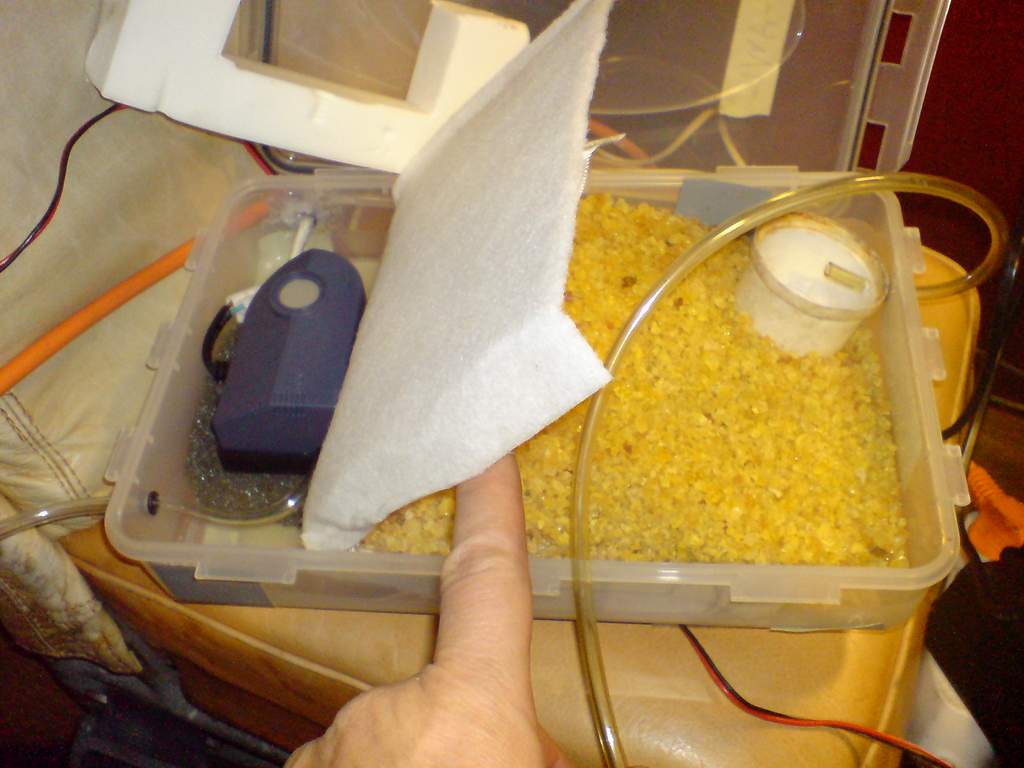
[Edit by Jorgen on Thursday, November 15, 2007 @ 03:03 PM]
Posted by Jorgen on Sunday, January 13, 2008 @ 02:37 PM:
Hi everyone,
hope you all had happy holidays and managed to avoid any reindeer-driven VFR-traffic with a red light up front. Just thought I´d try to blow some life in this interesting discussion that I´m sure all of us have opinions on or heard things about. Patrick mentioned build up of acids in the oil as a cause for internal engine corrosion. In this article (link below) the combustion by-products that contaminate the engine oil is called "blow-bys" and is said to build less in automotive engines, I guess because higher compression should imply that the piston rings seal better than on low compression aeroengines.
But if this is so there should perhaps be less acid build up but not zero. 20-hour oil is said to be "nasty stuff" and shouldn´t sit in an engine for too long, so maybe it´s best to do an extra oil change before the cold season or periods of less flying. How do you guys do?
Another question is whether to use thicker oil as advised in the article. Or perhaps molybdenium disulfide as mentioned by Bob as an oil additive? Anyone know under what name that is sold in Europe by the way?
The article can be found on:
http://www.avweb.com/news/savvyaviator/savvy_aviator_52_thinking_about_oil_changes_196730-1.html
Take 5(b) just 4 fun/ Jörgen, SE-UDI, SE-XST
Posted by JamesB on Tuesday, January 15, 2008 @ 11:02 PM:
A single weight oil probably does well. Personally, I wouldn't use oil thicker than recommeded in the POH. A thicker oil may coat better, but offers less lubrication--both on startup when wear is said to be highest and during normal operations.
Not too long ago a representative from Shell Oil Company gave a talk on engine oils. He made a particular point to argue that thicker oils do not offer better lubrication. He said that thinner oils circulate better offering better lubrication. He suggested that you should use the thinnest oil recommended for your vehicle for the conditions in which you drive. (Granted, he was addressing lubrication, not corrosion.)
He also noted that 40wt oil is the thickest that oils are naturally. Heavier than that is achieved through thickeners--which are not actually lubricants--just thickeners. So, per volume, a liter of 40wt oil has more oil in it than a liter of 50wt oil. Go figure.
Here in the U.S. Pacific Northwest, on one hand--we have a Lot of moisture. On the other hand, the weather is mild enough to fly all year long. So, I just cheat and try to fly once or more each week. The good news is that rebuilding the engine is not particularly expensive (esp. compared to a Lycoming/Continental).
Cheers -- the days are getting longer!
Posted by Bob Grimstead on Thursday, November 20, 2008 @ 00:12 AM:
Hi Guys,
Winter inhibiting our engines.
Molybdenum disulphide is marketed in England as 'Molyslip' but.... It is only for lubrication when you have no oil pressure (ie, when your Fournier is upside-down). So far as I know, although it is advertised as reducing internal engine friction, it has no corrosion-inhibiting properties.
When I store my aeroplanes for the winter (generally six months of disuse) I change the oil.
In the Lycoming and Continental, I use AeroShell 15w50 multigrade, because it has the best corrosion inhibitors of all aviation multigrades (BP/Castrol information). And of course, I use a multigrade for all the obvious reasons (see above).
For the Fourniers I use 'Castrol GTX for older vehicles', which from memory is a 15/50 multigrade.
I do the same in my old Jaguar & Land Rovers.
In every case, I get the engine good and hot (at least a half-hour flight or drive) before draining out all the old oil, and then leave the oil to drain at least overnight, tipping up the aeroplane to ensure absolutely all the old oil is out of the engine.
Then I add the fresh new oil and run the engine for 30 seconds to a minute.
The idea is to circulate the new oil all around the engine in its cold, sticky state, but not to let the oil heat up at all.
Thus, I hope everything inside the engine is coated in thick, slow-dribbling oil, which should stay on the surfaces for several weeks.
Then I remove the spark plugs, spray thin oil or ACF50 into the cylinders and replace them with desiccant plugs.
Finally, tape up the exhausts, breather and intake to prevent fresh, damp air from entering the engine.
Go away.
Come back six months later.
Untape the engines, remove the desiccant plugs.
Crank or spin the propeller by hand until thirty seconds of oil pressure (boy, but this is hard work on the Fourniers and the Champ).
Clean & replace the spark plugs.
Start engine, run for five minutes.
Thorough visual external check.
Go fly/drive.
Try to ignore the fact that none of this is any good for my engines, but is the best that I can practically do.
Does anybody have any better/additional ideas?
Yours, Bob

