Posted by jb92563 on Thursday, December 17, 2009 @ 04:58 PM:
When I bought my RF4D I had always envisioned using it to learn and practice aerobatics. (After some training of course)
I also promissed a special lady that I would draw a heart in the sky (Horizontal plane) with a smoke trail, for her as she actually helped convice me to go ahead and buy my RF4D even though the economy is a little shaky right now. (Not much arm twisting required)
So I am interested in installing some sort of smoke system in my RF4D so I can do a few minutes of sky writing.
Does anyone have any suggestions or leads on a system that might be suitable for an RF4D.
I did a search of the forum and turned up nothing.
--------------------
Posted by SteveBeaver on Thursday, December 17, 2009 @ 06:27 PM:
This company's products are very popular, but I'm not sure how suitable they are for a VW.
http://www.smokingairplanes.com/
Of course you need a smoke oil tank, some injector nozzles, a pump and a solenoid valve. Here are a couple of point to be aware of:
Positioning of the injectors is critical. Too close to the cylinder head and the smoke will burn, too far away and it will not fully vaporize. About a foot from the head is a good starting point.
The injectors are simple. There is typically no need to "spray" the oil, just squirt it from a heat proof tube.
A surprising amount of oil is required. A Lycoming O-320 will use about 0.8 gallons per minute at take-off power. Proportionally less for a smaller engine.
With one pipe per cylinder, you will probably see a chain of puffs rather than a continuous smoke trail
Steve
Posted by Bob Grimstead on Monday, December 21, 2009 @ 09:33 AM:
or, if you don't mind orange smoke, you could use marine distress smokes as we do. They come in 3-minute floating and 1-minute hand-held form, with various sizes of container and density of smoke.
You can put them on your wing-tips, tail or wherever you like, but beware:
a) they get extremely hot.
b) they sometimes (around 1 time in 20) burst into flame or explode instead of smoking. Then they become a real fire hazard to a wooden airplane.
c) so it's best to have your airframe covered in Polyfiber, which resists burning, rather than Ceconite, Diatex, cotton or linen, all of which burn quite well.
We tried setting a match to a piece of the original rudder fabric from Matthew's Fournier, and it virtually exploded in my hand, it burned so quickly. Nitrate dope, I guess (originally derived as a use for all the excess gun cotton -- nitro-cellulose -- left over after the First World War).
d) if you want a decent density of smoke, you need to have at least two smokes burning at any one time in each place (that is, on each wing-tip for us).
See the various photos on my aerobatics posts.
Yours, Bob
[Edit by Bob Grimstead on Monday, December 21, 2009 @ 09:35 AM]
[Edit by Bob Grimstead on Tuesday, January 12, 2010 @ 10:55 PM]
Posted by jb92563 on Monday, January 4, 2010 @ 08:02 PM:
How are the wingtip smoke canisters ignited? By Hand or Electrical ignitor?
Is the smoke can inside another container/fairing on your wingtips, or is it bolted directly.
How long does the smoke hang out on a calm cool morning?
I will soon be undertaking a little project to see if I can design a better smoke system using chemical ignited formulations.
I'll post the results, pictures and videos here.
If you have any ideas or requirements for an optimum system, post them here and I'll see if I can incorporate them.
1) First off I would like electrical ignition so I can chose precisely when to lite them and which ones to ignite (Colors).
2) For colors, I have seen that (Red/Orange)/white/blue will be possible.
3) Need at least 4 minutes of smoke.
4) Needs to be affordable, and DIY reproducable from available materials.
5) Cool exterior fairing to avoid/contain fire hazards
.
.
.
ideas?
[Edit by jb92563 on Monday, January 4, 2010 @ 08:08 PM]
--------------------
Posted by jb92563 on Tuesday, January 12, 2010 @ 12:27 PM:
I have made some chemical smoke but needs refinement of the formula to burn slower and cooler.
They burn rather hot but do not eject burning particles surprisingly, which I can't have happen if I want to be able to use them in the air.
I also need to design a wingtip smoke pod. At first I was thinking somehing akin to a Sidewinder, but in retrospect that might not be such good idea.
I have to make something rather benign looking.
I did have another idea.
I figure there are 2 ways to generate smoke. By Chemical burning process and by heated/vaporized smoke oil method.
Perhaps I can use an oil type generator on the tips as well if it was electrically heated. The benefit would also be that I could control the wingtip smoke then.
Time for experimenting down another track as well.
--------------------
Posted by SteveBeaver on Tuesday, January 12, 2010 @ 12:37 PM:
Hmm...
I calculate that it would take about 2,000,000 calories of energy per minute to turn enough oil into smoke at 100 mph. That is equivalent to a LOT of electricity 
Steve
Posted by jb92563 on Tuesday, January 12, 2010 @ 04:48 PM:
2,000,000 calories is only 97 watts.
Hmmmmm
[Edit by jb92563 on Tuesday, January 12, 2010 @ 04:52 PM]
--------------------
Posted by Bob Grimstead on Tuesday, January 12, 2010 @ 10:20 PM:
Hi Guys,
I guess I'm the current expert on Fournier smoke, having now used it in my displays for five years.
The original expert, who produced much more dense chemical burning smoke for the Skyhawks was Brian Esott, but he is dead, and he took his formula to the grave.

I do not propose to explain in detail 'how to do' this, because it is very dangerous. I am not joking. Here is a photo of me about to make a stall turn/hammerhead at the Red Bull Air Race final, Perth in 2008.

The smoke canister went off much louder than a shotgun (compare the size of a 3-minute marine smoke to a shotgun shell).
I was very lucky that, although the (flammable) foam nose fairing shot off ahead like a missile, it was light and fell gently into the cleared river below, injuring nobody.
I was even luckier that, despite splitting the pod wide open, the canister stayed on board and did not kill somebody.
Personally, I was lucky that the split canister did not jam my aileron.


I was also very luky that it did not set the wing alight.
I need to emphasize that this is not the only time this has heppened to me, but it was the only time I have photos of.
Yours, Bob
[Edit by Bob Grimstead on Tuesday, January 12, 2010 @ 10:20 PM]
Posted by Bob Grimstead on Tuesday, January 12, 2010 @ 10:29 PM:
Explosions (on the ground and in the air) are not the only hazard.
More frequently I get fires.
Again I do not have many photos, mostly because I am flying the aeroplane. If you look at my on-board footage for the Rygge airshow (on YouTube, FournierBob) you will see me repeatedly looking to the right. You will also see that, after the first stall turn/hammerhead (or maybe two, I can't remember) I do not make any more, and stick to wing-overs and other turn-around manoeuvres.
This is because my right wing pods were both well alight.
Here is a couple of photos taken at another display. Just one pod is flaming here. It looks inoccuous from the ground, but it looks like a kerosene hangar heater out at the tip. Flames a foot long are not unusual.


'Flamers' are much more common than explosions, and probably more dangerous.
They even happen from time to time to marine smokes when used in the normal way, but the directions say: 'pull string, throw into the sea'. If it burns in the sea, no problem, and presumably, if you are already in distress, a flaming smoke does not increase your danger and maybe gives you a little light relief?
Yours, Bob
[Edit by Bob Grimstead on Tuesday, January 12, 2010 @ 10:59 PM]
Posted by Bob Grimstead on Tuesday, January 12, 2010 @ 10:53 PM:
To answer your specific questions:
They are ignited by electrical ignitor, and NO I am not going to tell you how to do that. It is very hazardous, and the proper procedures for handling explosives have to be adhered to.
I still have a burn scar on my face (after nearly 50 years) from mis-handling explosives in my youth.
You could get somebody to pull the string before you take off, but can you climb to a safe/appropriate height and complete your manoeuvre (heart?) all within three minutes? If you can, then that's the way to go.
Are the smoke canisters in another container on your wing-tip?
Yes they are. We call that container a 'smoke pod'. It is faired, to minimise the drag, and we have conducted performance and spinning trials to ensure that there is no measurable performance decrement and no noticeable adverse effect on low-speed handling.
http://www.youtube.com/watch?v=69IEcYZXXnY
and
http://www.youtube.com/watch?v=GKXdQt-hvH8
also
http://www.youtube.com/watch?v=hron6ddfctc
You should do the same thing with your pods.
How long does the smoke hang around on a calm day?
This is the best I have seen.

Notice the smoke off to the left from my previous run the other way, a minute or so earlier.
It is usually still there when I go back for a second run along the A-axis, so I guess it lasts up to a minute or sometimes a little more -- enough time for four aerobatic manoeuvres, all of which seem to take about 15 seconds.
I engaged a chemical engineer (smoke expert) to undertake a feasibility study of smoke generated by spraying appropriate liquids (glycol?) on to a hot plate heated by butane/propane. It seemed feasible, and possibly safe, but the smoke density was insufficient.
http://www.pea-soup.com/buy-vicountcompact.shtml
I urge you to be highly professional and very, VERY careful with your experimentation.
Yours, Bob
Posted by SteveBeaver on Wednesday, January 13, 2010 @ 09:53 AM:
My (revised and optimistic) calculation went like this and is based on the vague guess that the temperature of the oil needs to be raised by about 300 degrees C to make smoke. The vapor point of motor oil is much less than that, but that is a different property. Engine exhaust runs at about 1000 degrees F at high power settings and oil is injected at about the same place the EGT probe goes, but perhaps you don't really need it that hot?? Anyway, I used 300 C:
You need to heat 2000 CC of oil by 300 degrees every minute.
That is 2000 x 300 x 0.8 (The specific gravity of motor oil) = 480,000 gram calories (as opposed to food calories)
1 calorie = 1.163 x 10^-6 KWH so that is the same as .55 KWH or 550 watts for an hour.
You need to perform this task in one minute though, so you will need 33 KW. At 12 volts, that is 2,700 Amps.
Is this reasonable? - Not sure. Certainly if you dunk a 100 watt light bulb into half a gallon of oil, it isn't going to do a heck of a lot in one minute, or even one week
Steve
Posted by jb92563 on Wednesday, January 13, 2010 @ 11:57 AM:
I appreaciate all the comments, observations and suggestions.
The reference info gives me a good idea of the challanges I'll have to address.
Obviously, I'm going to be very cautious and safe, and read all your warnings loud and clear.
It will be at leat a year before I even get to the stage of having something I might want to install on the plane.
My first priority is learning and practising aerobatics and I certainly dont need any distractions like burning wingtips.
It sounds like there is a bit of room to inovate and perhaps some out of the box thinking might yield some improvements to
the established methods of smoke generation.
I think that the wingtip smoke aerobatics are very pretty and unique, serving to quite nicely highlight the longer wings and slower gracefull manuevers of the RF4D and has inspired me to work towards that goal as well, perhaps coming up with a better way to do it that I will be glad to share with other enthusiasts.
So far I have done 2 experiments:
1) I made a standard batch of the chemical, and made a 2" dia cylinder 3" long. Drilled a hole down the center for a fuse.
It burns hot and fast and produces a lot of dense white smoke, lasting about 30 seconds.
2) I then tried a slower formulation made into a cylinder 1" dia by 3" long, ignited on the end face(not down the center) and got 30 seconds
of burn time with a moderate amount of smoke.
Results: I think shape and burn area are very important, as is slowing the burn rate by the composition proportions.
I'll continue to post my results here as things progress and get some movie and picture links up, of my experiments.
Since I live in a residential area I have been doing my experiments in the BBQ in small quantities so as not to freak out the neighbors.
I think my regular BBQing produces much more smoke than my experiments anyway 
--------------------
Posted by Bob Grimstead on Wednesday, January 13, 2010 @ 07:19 PM:
Hi again Ray,
My buddy Guy Westgate had a small professional firework manufacturer make some smokes for him, but unfortunately they went bust before delivering in quantity.
However, during their work they found that the burned residue within the cardboard smoke tube (carbon) makes a great smoke-absorbing filter. Thus, after a minute or so of burning, a solid plug 's smoke becomes thinner and thinner.
The answer was, as in your first experiment, to have a hole down the centre, and get the compound burning from the inside out. Doing this gave approximately the same smoke density for the full three minutes.
I also have some assumed/derived info on the chemicals used in the Skyhawks' smokes, which I shall send my e-mail.
Yours, Bob
Posted by jb92563 on Thursday, January 14, 2010 @ 12:16 PM:
That solid versus center holed difference may explain the reduced density of smoke to some extent.
I think the shape is quite important to get right.
The mixture I am using is the simple Potasium Nitrate(oxydizer), Sugar (fuel) and Baking Soda (Moderates the rate of burn).
I have another formula from a fireworks producer that has sulfur and charcoal replacing the fuel, however I suspect the charcoal is just going to add glowing embers to the smoke that I really dont want.
There will be a lot of experimenting ahead with shapes, formulations and fairings.
I also want to make a fairing chamber that makes the smoke travel through a few inner passageways that increase the distance the smoke / flame travels iinside the fairing before exiting so that any burning particles or flame is contained and burned out by the time it exhausts from the fairing.
Think of is as as a few loosely nested cylinders closed at alternate ends that will cause the gasses to flow through all the spaces between the cylinders before exiting.
--------------------
Posted by Bob Grimstead on Thursday, January 14, 2010 @ 09:20 PM:
Hi Ray,
Take care now, you do know how close your mixture is getting to gunpowder, don't you?
I would heartily suggest:
a) you encase your mixture first in a cardboard container rather than something more solid. The more solid the casing, the closer you get to a bomb.
b) you have a tube or hole in the nose-cone directing cold air on to and around your smoke canister to keep it as cool as possible.
Yours, Bob
[Edit by Bob Grimstead on Saturday, January 16, 2010 @ 09:10 AM]
Posted by jb92563 on Friday, January 15, 2010 @ 12:55 PM:
Yes, I have made gun powder before as well, many years ago when I built model rockets I also made my own rocket motors so i have already done a lot of experimenting in that area as well.
I am also aware of the effects of enclosed or overly restricted vessels containing burning mixtures, shock waves, burn fronts
and the somewhat unpredictable performance of solid or loose burning mixtures etc
I have not enclosed my mixtures at all yet, until I can establish a low enough burn rate, and even then when I do enclose them I will have relief from overpressures build into the design of the container.
Last thing I want is a burning mixture to reach presures at which explosive decomposition occurs.
Inflow of cooling air is a great idea and I had thought of that with the nested cylinders idea to maintain a cool outer casing.
I'll also make the container out of light aluminum and carbon fiber to reduce the risk from flying schrapnel should the thing burst.
--------------------
Posted by jb92563 on Thursday, January 28, 2010 @ 06:08 PM:
I will start posting my experiments here:
The Picassa link at the bottom will have an "Experiments" album for other photos not included here.
The failures and development information is just as interesting to learn from as is the eventual successful result, plus there may be some entertainment factor as well, so here it goes:
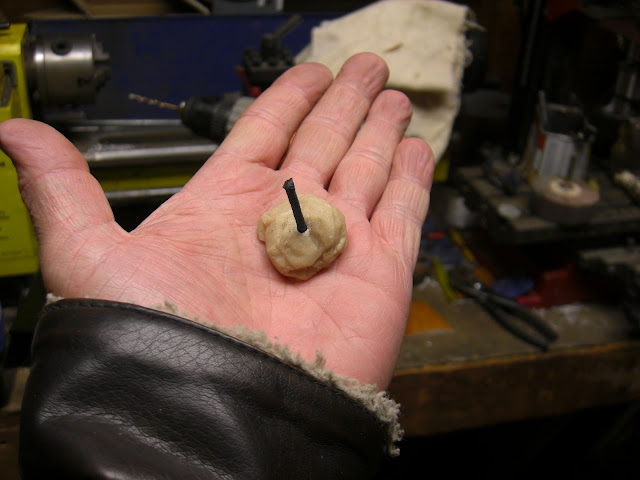
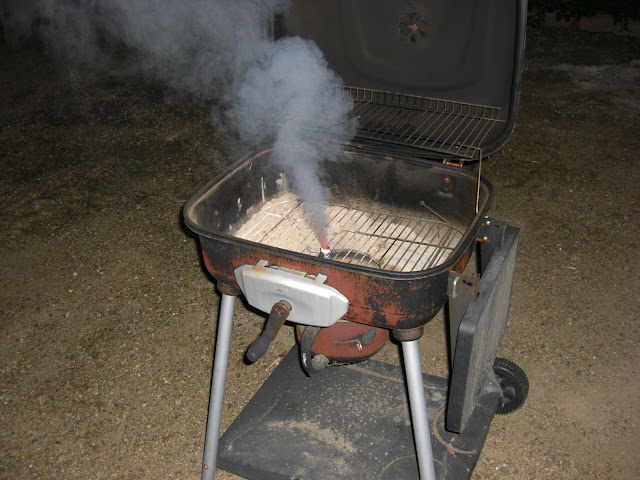
Experiment #1
It was 1.5" dia cylinder 0.5" tall with ignition through a hole formed down the center and fuse ignited.
It was what I will call the STD mixture.
It burned for 4 seconds and produced a lot of smoke but far too much heat and flame.
The video of Experiment # 1 =>http://www.youtube.com/watch?v=C8sxrs-PkRo
All the sparks are from the fuse, not the mixture.
Experiment #2
It is a 5/8" dia cylinder 2.75" tall with ignition on the face via fuse.
It was the STD mixture + 10% moderator "A" to slow the rate of burn.
It burned for 21 seconds and produced a low quantity of not very dense smoke.
Another Idea: There is a carb cleaner that you run through your auto engine and produces a huge volume of white smoke as it cleans your carb. I must find out more about this product when experimenting with the liquid smoke generation approach.
Disclaimer: Don't try this yourself as grave injury and destruction will result if you do not take the proper approach and precautions.
[Edit by jb92563 on Thursday, January 28, 2010 @ 08:26 PM]
--------------------
Posted by SteveBeaver on Tuesday, February 2, 2010 @ 11:18 PM:
Manfred Radius' smoke system:

Posted by jb92563 on Wednesday, February 3, 2010 @ 02:34 AM:
I can hardly stop laughing....you can't be serious. 
That looks like a disaster just waiting to happen
--------------------
Posted by SteveBeaver on Wednesday, February 3, 2010 @ 10:15 AM:
Don't laugh. Manfred is by far the most successful glider display pilot in the biz and has been using this system for many years. I suspect though, that all these fireworks on the wingtip are just that. - Fireworks.
As well as his daytime shows, he does a night-pyro display in the Salto and this assemblage may be for that, not just the smoke he uses for daytime displays. That would also explain the nav light lash-up.

I understand it takes him about 4 hours to build the system for each pyro show.
You can view some of his magic here: http://www.radiusairshows.com/mpeg.mpg Lots more on YouTube.
Posted by jb92563 on Wednesday, February 3, 2010 @ 11:22 AM:
I've seen Manfreds displays in Ontario, Canada in 1997.
He came out to our glider club and put on a practice session for us, complete with music etc.
He has an incredible aerobatic talent that leaves even a glider pilot awestruck.
It just seems like such a huge draggy package for a wingtip and with a mess of wires and so many pyro
devices out there in a bundle.
Is there no fairing for all that?
Hopefully the wingtips and control surfaces of the Salto are all fireproof.
--------------------
Posted by Bob Grimstead on Wednesday, February 3, 2010 @ 10:38 PM:
Hi Guys,
The appearance of Manfred's kit makes my hair stand on end.
But then, so does the idea of flying night aerobatics while being blinded by pyrotechnics.
The drag isn't too much of a problem. For a year I flew with marine smokes sprayed silver and just held in place on the old pod carcasses with big hose clamps, thus:

There was no noticeable decrease in performance. It just looked horrible, and you can imagine the reaction of any agent of the local certification authority!
Thus now something which looks (a bit) neater.
Yours, Bob
Posted by jb92563 on Friday, February 5, 2010 @ 03:19 AM:
I emailed Manfred Radius to inquire about the smoke he is using.
He uses white smoke from this source:
http://www.superiorsignal.com/superior043.htm
(White smoke ~4 min is $34 USD each with a Hazmat fee of about $25/box bringing the unit cost to $37)
If the price is reasonable this could be just the thing I am looking for as they are not very bulky, produce lots of smoke and have a good burn duration.
One from the commercial Marine distress smokes, and one from commercial fireworks products.
I also found some ready made sources used for paintball smokes that brings down the unit cost to around $24.
I also discovered all kinds of detailed smoke formulations at the patents online office, some dating back to 1919.
Actually my own formula is close to some and there are good instructions for perfecting the mix for optimum results.
I am most excited by a flameless formula that does not heat beyond 300 F and is rather safer than many of the others.
There is also an article about skywriting in the current Jan Issue of EAA magazine that utilizes used transmission fluid in the exhaust to generate smoke. The fluid is typically $0.25/gal.

