| Author |
Messages |
Jorgen
Unregistered

|
      
 Posted Monday, May 7, 2007 @ 06:39 PM Posted Monday, May 7, 2007 @ 06:39 PM
Hi,
As I confessed in the "modifications" section I broke an outrigger on my RF 4 (due to my own fault). Now I managed the same on a RF 5b in a cross-wind landing.
I wonder if anyone knows if there is any recommendations for how many hours you can fly before it´s time to change the nylon struts of the outriggers and what quality is recommended? As I understand it, the nylon rod outriggers are a modification (at least on the RF 4) since the original design was hoops or semi circular metal arcs (with wheels), correct? And if so, a lot has happened in the wonderful world of plastics lately so maybe there is room for improvement. Such as smaller diameter rods with better bending caracteristics, fatigue tolerances etc.
My local plastic dealer thought the nylon rod I ordered was stone-age, heavy and expensive. On the other hand, I tried out the PE (Poly-Eten?) rod he suggested and it was much to weak. Dave Bland in the UK said he was looking for a smaller diameter nylon rod with glassfiber reinforcement, but I haven´t found anything similar.
Another thought is the length. A shorter outrigger would, at least in theory, allow better cross-wind capability, but I guess the rudder size is the main factor there. And there is probably a limit to how much side-wise punishment the undercarrriage would tolerate in the long run.
Or has anyone dared design a foldable outrigger...? I saw a neat design on a Windex glider during EAA Sweden´s fly-in, but I haven´t laid my hands on the drawings. Yet.
Just 4`fun/ Jörgen, SE-XST
|
SteveBeaver
Unregistered
|
Posted Monday, May 7, 2007 @ 09:06 PM
I am experimenting with 6mm and 8mm "pull-truded" carbon fiber rod at the moment. It looks very promising and I will post the results here as soon as I am sure about them.
Here is an example: http://www.graphitestore.com/itemDetails.asp?item_id=1095&prd_id=96&cat_id=34&curPage=2
More soon. - Steve
|
JamesB
Unregistered
|
Posted Tuesday, May 8, 2007 @ 10:57 AM
Are Scheonwald's outriggers a good solution for grass?
|
eugenio
Unregistered
|
Posted Wednesday, May 16, 2007 @ 10:55 AM
Schonwald's outriggers are fine indeed.
In any case I solved the problem using reinforced nylon rods (RS code 771-8119) 25mm; it is the same diameter of the standard nylon rod but a little stiffer.
It works fine on grass and macadam.
Only one advice: the leg must be fixed only with the original clamping system from above the wing, or if you want to fix it with a bolt thru the support and the leg, you must lenghten the support pipe in order to have at least 3 cm-1/2 inch between the bolt hole and the lower side of the pipe, otherwise the leg will always break at the hole level.
This is valid for all RF's with outriggers.
Eugenio
|
sericson
Unregistered
|
Posted Wednesday, May 16, 2007 @ 05:55 PM
Does anyone have drawings or bill of materials for Schonwald's outriggers? Are they available for purchase?
Steve
N505SE
|
JamesB
Unregistered
|
Posted Wednesday, May 16, 2007 @ 11:05 PM
RS code 771-8119 ?
Sorry, I don't know what that means or how to use it to order materials.
Would you take a minute to clarify?
Thanks.
|
Collin
Unregistered
|
Posted Thursday, May 17, 2007 @ 03:58 PM
Hi Steve and James,
I have a pair of Schonwald's outriggers if you want to see them I can send one to look at. The only thing I would change is use a larger roller blade wheel. I think the cost was about $350 US.
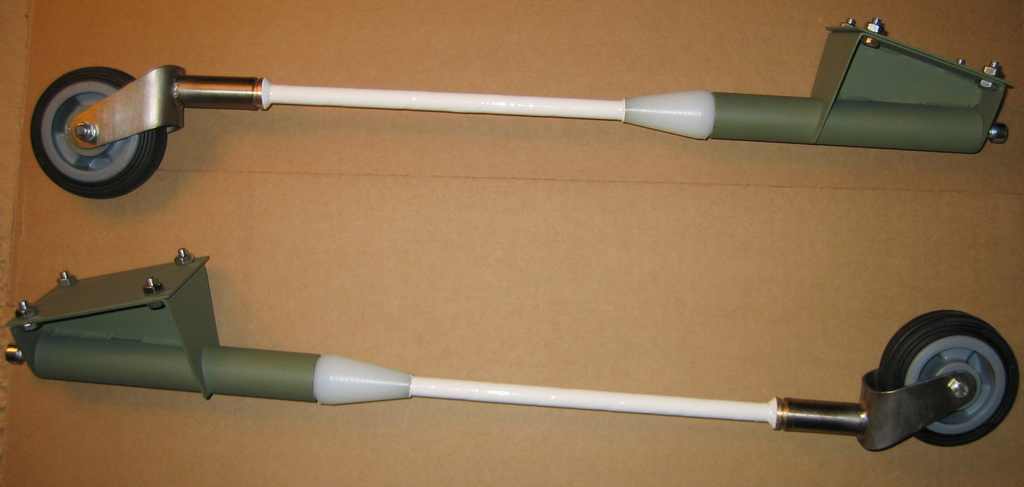
--------------------
|
Jorgen
Unregistered
|
Posted Friday, May 18, 2007 @ 07:18 AM
Hi everyone,
nice to hear I´m not the only one to give the outrigger some thoughts. It seems there are some room for modification
(I wouldn´t want to call it improvement out of respect for Monsieur Fournier, bless his gifted soul) regarding the outriggers.
One question: is the "Scheonwald"-type wheels free-swiveling (or turning, castoring)?
That would be one way of reducing loads on the strut. Maybe you risk getting some extra lateral loads on the main gear but it shouldn´t be that much greater. If you have a free swivelling wheel you mainly have loads towards the rear which perhaps could
make a lighter, blade-type strut with more controlled stiffness feasible. Nowadays glassfiber battens for sails can be bought with any desired stiffness and in any exotic material you want. But of course it´s simpler to just buy a stiffer nylon rod.
Eugenio, per piecere, sai si che un altra tipo di designazione per il puntello di nailon?
Just 4´fun/ Jörgen, SE-XST
|
eugenio
Unregistered
|
Posted Tuesday, May 22, 2007 @ 02:21 PM
Schonwald's caster is fully swivelling, and is very useful especially when you mouve the aircraft in the hangar pushing it by one side.
For the nylon outriggers look on RS online catalog http://www.rs-components.com/index.html and check for the code Materiali plastici,nylon 66,caricato vetro,asta,nero,25mm dia,1m
Codice RS 771-819
Costruttore ERTA
Codice Costruttore 771-819 S Y 1
N Disponibile
The number I gave previously was wrong.
The price is for 2 bars of 1 meter. Usually with one bar you can do the two outriggers.
Eugenio
|
SteveBeaver
Unregistered
|
Posted Tuesday, May 22, 2007 @ 02:38 PM
Readers in the USA can find the same material at www.mcmaster.com The part number is 8538K23 and it is the equivalent of $9 per meter.
Steve
|
Jorgen
Unregistered
|
Posted Sunday, June 10, 2007 @ 04:44 PM
Grazie tante per la sua cortesia, Eugenio.
I am green with envy with all you guys that went to GAP, unfortunately I couldn´t make it. Hope for a next time though!
RS components run a tight ship, it took only a couple of days to get the rods. I re-fitted it today and I feel a lot more confident with it. It will resorb energy and bend when loaded but bounces right back up.
Next mod will probably be rollerblade wheels instead of the heavy metal-type I have at the moment. The speed skaters are using 110 mm wheels and some 120 mm are available. They are light and with sealed, standardized bearings. Anyone found a good wheel with flat sides (spokes induce drag!)?
Just 4 fun/ Jörgen, SE-XST
|
sabatig
Unregistered
|
Posted Monday, June 11, 2007 @ 02:55 PM
Hi All
How do you change the outriggers on the Rf3/4?? i was looking at it wondering last week..Do you need to cut open the wing?
Thanks
|
Jorgen
Unregistered
|
Posted Tuesday, June 12, 2007 @ 04:40 AM
Hello Sabatig,
depends on what fitting you have since most are modifications of the original design. On my RF 4 (previous G-AVNX) the modification is UK-made and there is no spreader dowel at the end of the rod (my previous posts discussed the outrigger on a RF 5 b) so there´s no screw attached through any hole on the upper surface of the wing.
If you have that type of fitting you just undo the bolt in the wing-mounted fitting under the wing and take it out. You might need som W-40 anti corrosion spray or similar to facilitate getting it out though. And sometimes an adequate amount of violence. [IMG][/IMG] It might be even tougher to get the plastic rod out of the wheelfitting, I had to drill the rod to pieces to get it out.
Getting back to the original question I would suggest that if you have a deformation of your rods ("not straight anymore" it´s probably subjected to material fatigue and it might be a good idea to replace the rod before it breaks. it´s probably subjected to material fatigue and it might be a good idea to replace the rod before it breaks.
Just 4 fun/ Jörgen, SE-XST
|
Jorgen
Unregistered
|
Posted Wednesday, June 18, 2008 @ 04:36 PM
Hi again guys,
"-Ooops, I did it again" as the song goes....Broke the reinforced (nylon 66) outrigger on the RF 5 b today. No crosswind, but I managed to dip the outrigger in some high grass at the edge of the strip, which at the moment is a bit to narrow, just before touchdown. Fortunately no other damages.
Contributing factors: Poor alignment of the outrigger wheel (a significant "toe-in", collision with grass/weeds and above all; a cracked fitting with (and this is the embarrasing part) a bolt only a centimeter from the underside of the fitting. If you look at Eugenios first post in this topic you can see that he already foresaw that. I now recognise Eugenio as the "Merlin the Magician" of Fourniers....
One question though: if you only fix the outrigger leg with the spreader dowel (or bolt) at the top to avoid drilling holes were the outrigger leg has it´s peak stresses, how do you control the "toe-in/toe out" of the outrigger wheels?
(Edit) The answer came in my sleep: -Free swivelling wheels, of course.
Take 5(b) just 4 fun/ Jörgen, SE-UDI, SE-XST
[Edit by Jorgen on Thursday, June 19, 2008 @ 02:06 AM]
[Edit by Jorgen on Thursday, June 19, 2008 @ 05:25 AM]
|
eugenio
Unregistered
|
Posted Monday, June 23, 2008 @ 03:47 PM
If you do not want to break the outriggers too often here you are some tips:
Nylon 66 is the right choice
Upper bolt is OK, thru bolt on the support is OK if at least 2/3 cm from the edge, a 4mm bolt is enough.
Wheels must be 8cm diameter rubber, must be aligned and no need to be swiveling
Pneumatic wheels stress more the outrigger, smaller ones skids easily
Keep your outriggers a little shorter, you will have more distance between the wheel and the runway, outriggers only have to keep the wing while standing or starting to move, on take off and landing you are on the main wheel!
Ah, please I'm not Merlin the Magician, I am one that works on Fourniers, especially on mines, so I already did some of the mentioned mistakes or I saw those made by others.
cheers
Eugenio
|
Bob Grimstead
Unregistered
|
Posted Tuesday, October 21, 2008 @ 08:39 PM
Hi Guys,
There was some correspondence about lengths.... no, I won't be drawn...
My left one is 43cm from wing undersurface to underside of rollerblade wheel, the right one is 44cm ditto.
Both are slightly bent from my wheel-up landing, but still serveceable.
I have a couple of brand-new EIS outrigger rods, they are white nylon, and 57 cm long.
Eugenio said you could make two from a single one-metre length, which seems good.
Yours, Bob
[size=small][Edit by Bob Grimstead on [TIME]1225675369[/TIME]][/size]
[size=small][Edit by Bob Grimstead on [TIME]1241806895[/TIME]][/size]
|
Bob Grimstead
Unregistered
|
Posted Tuesday, October 21, 2008 @ 09:23 PM
Hi Guys,
Whenever something interesting turns up on this site (which is practically weekly), I copy-n-paste it into a Word document, print it out and take copies down to the hangar to file under: 'expected future maintenance'.
Thanks to this anal habit of mine, here is some of the lost thread, copied and pasted a few weeks ago. It's not all there, but there is some info.
Unfortunately I can't get the photos off this document.
Yours, Bob
The first picture shows one of my outrigger sockets from which it is evident that it's not doing too well.
The base plate is far too rigid where the two tubes attach and insufficiently rigid elsewhere. Any landing load on the outrigger causes the assembly to pivot backwards on the rearmost point of the welded area generating a large prying moment on the front screw and causing a sharp bend at the front of the weld area. I have straightened that bend on many occasions and really it's only a matter of time before embrittlement goes too far. Another concern is that there is evidence of localised crushing of the wooden structure above the aft end of the large socket. It's not much but it's there and it shouldn't be. To my mind the arrangement would have been better with the large socket for the nylon leg ahead of the small socket for the 9mm pin.
The second picture shows the leg and the 9mm diameter steel pin which bridges the wing/socket joint.
As described before, there is a steel tube in the wing to receive that 9mm rod but I don't know if that tube is part of an original fitting or a later addition. If it is the remnant of an original fitting similar to that illustrated in the RF4 Parts list I would expect to find evidence of access to the retaining nut under the wing upper surface, but cannot. My magnet detects no metal close beneath the wing upper surface.
You can also see from that second picture that the 9mm pin is slightly bent, as is the 25mm diameter nylon leg. I put most of the bend into the nylon the time I landed gear-up, but they didn't break. Now that I have some new nylon rods to play with I'm sure the existing legs are nylon 66, which agrees with what Eugenio writes.
My final picture is of the original or near-original set-up on Sabine Humm's RF4 which I liked very much and which, to my mind, illustrates some of the features desirable in a new scheme.
From the illustration in the RF4 Parts list it is clear that the main connection between the in-wing fitting and the outrigger leg is via the aft-most of the two sockets. The socket is further stiffened by the inclusion of a tie-down loop and that socket assembly must be fairly uniformly stiff along its' length. The manacle clamp and the wire brace to the trailing edge will make the upper part of the entire outrigger assembly stiffer over a longer base length in the fore/aft direction than the lower leg which is clearly intended to take most of the deflections. The rearwards bend at around 60% of the leg length will add a valuable suspension element to attenuate aftwards loading of the leg and thus prying of the socket from the wing.
These are my opinions on all of this. My main concern is how to make a reliable connection between the wing and the outrigger. My present system seems unsatisfactory, though it hasn't broken or fallen off in the 12 years I have had the aircraft, it offends me and seems amateurish. I'd like something better. Donald
|
Bob Grimstead
Unregistered
|
Posted Tuesday, October 21, 2008 @ 09:26 PM
Schonwald's outriggers are fine indeed.
In any case I solved the problem using reinforced nylon rods 25mm; it is the same diameter of the standard nylon rod but a little stiffer. It works fine on grass and macadam.
Only one advice: the leg must be fixed only with the original clamping system from above the wing, or if you want to fix it with a bolt thru the support and the leg, you must lengthen the support pipe in order to have at least 3 cm-1/2 inch between the bolt hole and the lower side of the pipe, otherwise the leg will always break at the hole level. This is valid for all RF's with outriggers.
Schonwald's caster is fully swivelling, and is very useful especially when you mouve the aircraft in the hangar pushing it by one side.
For the nylon outriggers look on RS online catalog http://www.rs-components.com/index.html and check for the code Materiali plastici,nylon 66,caricato vetro,asta,nero,25mm dia,1m
Codice RS 771-819
Costruttore ERTA
Codice Costruttore 771-819 S Y 1
N Disponibile
The price is for 2 bars of 1 meter. Usually with one bar you can do the two outriggers.
If you do not want to break the outriggers too often here you are some tips:
Nylon 66 is the right choice.
Upper bolt is OK, thru bolt on the support is OK if at least 2/3 cm from the edge, a 4mm bolt is enough.
Wheels must be 8cm diameter rubber, must be aligned and no need to be swiveling.
Pneumatic wheels stress more the outrigger, smaller ones skid easily.
Keep your outriggers a little shorter, you will have more distance between the wheel and the runway, outriggers only have to keep the wing while standing or starting to move, on take off and landing you are on the main wheel!
The original system used white nylon rods, a little more elastic than the black nylon 66, but the disadvantage is that if you bend it once it will become softer and will bend again, plus in summer they get softer, result is that you will rasp the wingtip and the aileron trailing edge on the runway.
This is why the Nylon 66 is better. If you land wheel up the nylon 66 will break, while the white nylon, unless it is very cold outside, will just bend, but the result is the same, you will have to put in a new rod.
If the rod support is well fixed to the spar it will not move, otherwise it will take more play. If the support is worn out by the rust you have to install a new set, otherwise sooner or later it will break, the same for the fastening bolts.
Schonwald outriggers work the same way, they only are a little more sophisticated and nicer to see, but they too break in case of wheel up landing. Also the older steel rods had their problems because in case of belly landing you often will break the trailing edge where the rod was fixed (rear support).
So, in conclusion, the best thing is always to land on your main wheel as Mr. Fournier thought when designed the aircraft. Eugenio
Readers in the USA can find the same material at www.mcmaster.com The part number is 8538K23 and it is the equivalent of $9 per meter. Steve
Hi Steve and James,
I have a pair of Schonwald's outriggers. If you want to see them I can send one to look at. The only thing I would change is use a larger roller blade wheel. I think the cost was about $350 US.
--------------------
Collin Gyenes RF4D N2182 #4065
Here is a photo of my original outrigger fitting. Sam Mason
On SE-XST (previous G-AVNX) previous owner Mike Wollard upgraded the outriggers in 1995 when he repaired a wing damage, which I´ve mentioned before. I speculated that the 10th rib, where the outrigger is fitted is hollow, but that´s not correct, which can be seen in these pictures that Mike took on (then) G-AVNX. The 10th rib is reinforced with a block of Ashwood with cut-outs for the aileron push-rod and a tube (for electrical wires to smoke cannisters? There is a socket at the wing tip on SE-XST) and drilled holes for the fitting itself.
I´ve sent scanned drawings of the fitting itself to Collin for posting, I even have the fax number to the UK firm that manufactured the fittings, if they´re still in business. What other outrigger fittings are out there? Care to share?
Take 5(b) just 4 fun, Jörgen, SE-UDI, SE-XST.
|
Jorgen
Unregistered
|
Posted Tuesday, May 5, 2009 @ 12:30 PM
Thanks for the text recovery, Bob. I am starting a new thread on the length-issue...
Take 5(b) just 4 fun/ Jörgen
|
|

