| Author |
Messages |
Ray Phillips
Unregistered

|
      
 Posted Tuesday, February 7, 2012 @ 05:04 PM Posted Tuesday, February 7, 2012 @ 05:04 PM
What is everyone using for a cylinder head temp probe? We have the type that goes under the spark plug and would like to change to something different.
--------------------
|
dannparks
Unregistered
|
Posted Tuesday, February 7, 2012 @ 05:58 PM
Aeroconversions has some "screw on" probes. I have no direct experience with them, but I'm planning to use them. Scroll down the page.
http://www.aeroconversions.com/products/accessories/index.html
--------------------
|
Collin
Unregistered
|
Posted Tuesday, February 7, 2012 @ 09:18 PM
Hello,
I have a CHT probe under top middle head stud washer. The probe part number is 10-01441 from Aircraft spruce. The temp reading is about 100F (40C) less then measuring at the spark plug. Measuring under the middle head washer gives more an average temp reading. I see about 225F (110C) cruse 275F (135C) climb and taxi.
Collin
|
Ray Phillips
Unregistered
|
Posted Wednesday, February 8, 2012 @ 08:29 AM
What are you thoughts about putting the probe under tha pal nut? This would put it on top of the head nut. This would save us from dedoing all of the head nuts.
--------------------
|
Donald
Unregistered
|
Posted Wednesday, February 8, 2012 @ 10:52 AM
I've just broken my CHT probe which fitted under a spark plug. That type seems very vulnerable when screwing the plugs in and out so I quite like the look of the AeroConversions probe that Dannparks linked to although it's a little remote from the heat source so I'm not sure how accurate it might be, or I could just remove the gauge.
Not sure what I think about putting it under a head stud nut. Is that a common practice?
|
Bob Grimstead
Unregistered
|
Posted Wednesday, February 8, 2012 @ 11:30 AM
Hi Guys,
I have sheared off a couple of those probe washers that fit under the spark plugs, so I don't use them any more.
I am told that some later VWs with fuel injection used CHT probes in drillings on the heads, but I don't know where the drillings are, nor whether these probes can be obtained and whether they can be used to get a temperature read-out.
I am reluctant to use a washer probe under a cylinder head nut, because those washers are soft, and that just invites allowing the head nut to loosen, with consequent head leaks, erosion and general stuffing up of the heads.
Rene & Rectimo didn't think a CHT was necessary, so why should we?
Where can we find the 'correct' CHT reading and a CHT maximum -- only guesswork so far as I know...
Yours, Bob
--------------------
|
Collin
Unregistered
|
Posted Wednesday, February 8, 2012 @ 09:24 PM
Hi,
I have had my RF5B now for just over two years now. One of the reasons it was for sale is it was over heating. The baffling was in very poor shape and I think the compression ratio was to high. Now with the new engine, new CHT gauge and cleaned up baffling. I know now what is normal temps for my set up. So if there a a carb, baffling or mag trouble or flying to slow with to high of a power setting I will know.
The RF4 is much lighter and faster so it does not have cylinder temp troubles.
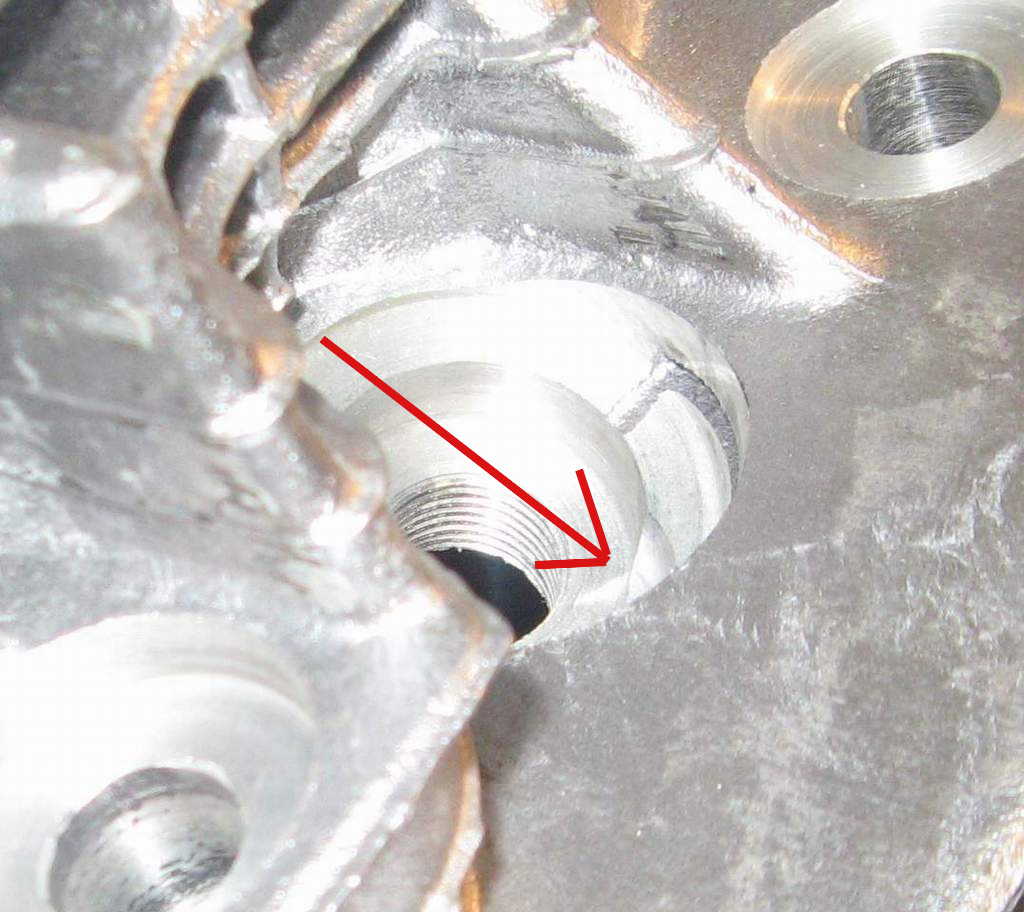
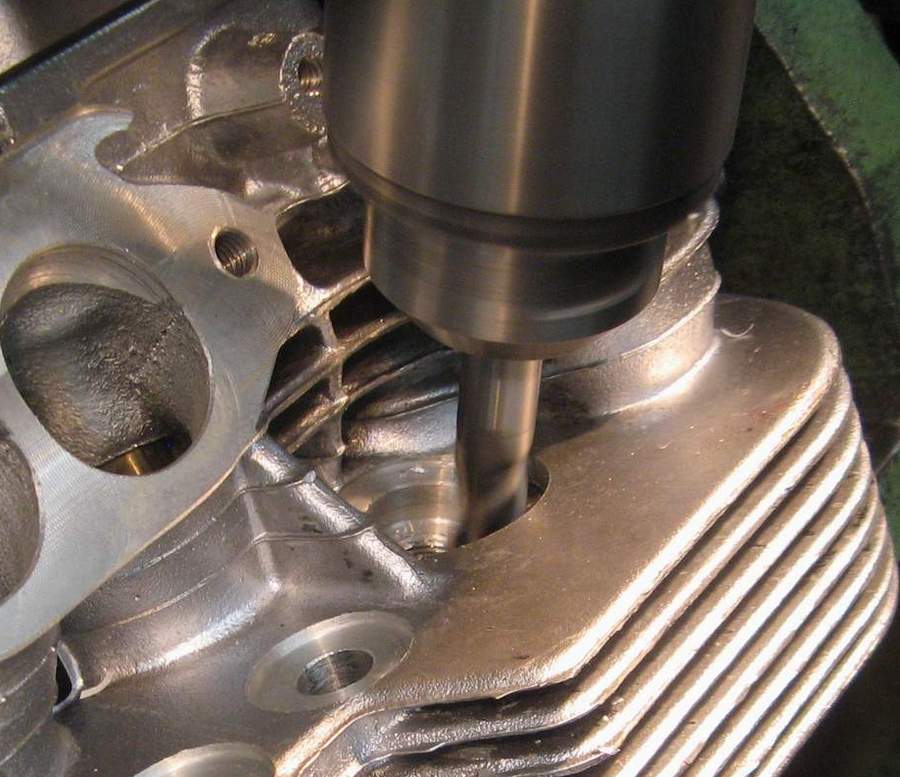
Here are some pictures CHT temp mod to new heads.
|
Bob Grimstead
Unregistered
|
Posted Wednesday, February 8, 2012 @ 09:52 PM
Hi Collin,
That's a great solution to having the wire shear off the CHT washer.
Unfortunately, although they are lighter and faster, many RF4s do have over-heating problems.
When I bought my Red one it had marks inside the rear right combustion chamber caused by the head of a valve that had broken off.
I know of several other RF4s that are running so hot that they need to have the heads off and the valves gound in every 100 to 150 hours.
My blue one has good baffles and extra cooling mods, and although I fly it always at full throttle and in high ambient temperatures, I have never had to remove the heads and grind in the valves or any other over-heating symptoms.
If the cooling air intake and oultlets are big enough, and the baffles are all in place and fit tightly EVERYWHERE, there should not be too much of a cooling problem, even when increasing power to 1400cc and 8.2 to 1 compression ratio --- I think.
Yours, Bob
--------------------
|
Mike-RM
Unregistered
|
Posted Saturday, March 17, 2012 @ 03:46 PM
Our RF5 has always had a dual CHT gauge with sensors under the rear two plugs, and the head was releved in that area, like Collin's photo indicates, so I assumed it was standard. It doesn't completely stop potential damage when unscrewing plugs however, you just have to be very careful.
The curious thing is that we also suffered overheating at climb power, quickly rising to the max permissible temp. That was until I had to replace the heads with new aftermarket ones, for other reasons, and it immediately ran 50 deg F cooler in the climb. It hardly ever rises much over 400-450 deg F at full power now. The baffling was the same and included the important baffle between the cylinders, so I was puzzled but very pleased with the outcome.
|
Mike-RM
Unregistered
|
Posted Saturday, March 17, 2012 @ 05:07 PM
I just looked back to a thread started in 2007 about engine baffles and realised that there is a difference between my old heads and the new ones. Although the inter-cylinder baffles were in place before and after, the new heads have the small baffles on the undersides of the heads, which were not present on the old heads. Must make a surprising difference!

[Edit by Mike-RM on Saturday, March 17, 2012 @ 05:08 PM]
|
Donald
Unregistered
|
Posted Sunday, March 18, 2012 @ 04:04 AM
Last year I sourced a couple of unused 'Mexico' heads that have these little baffle plates. None of my previous heads had them.
|
|

