| Author |
Messages |
Bob Grimstead
Unregistered

|
      
 Posted Tuesday, July 7, 2020 @ 11:22 PM Posted Tuesday, July 7, 2020 @ 11:22 PM
I don't have time right now to give you all the details, but so far the components of my smoke system have cost absolutely nothing and the smoke oil itself cost me $13.80
View this clip to see the result.
https://youtu.be/TqCjwx6PDw8
Why did the components cost me nothing? Because they all came out of my scrap bin.
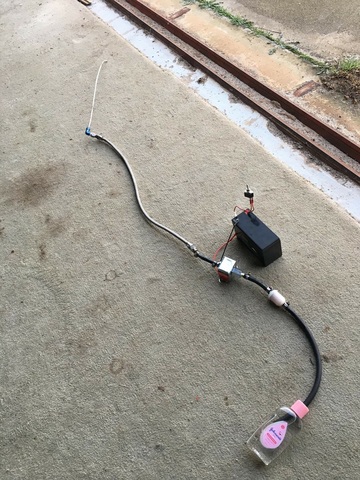
More later, Bob
[Edit by Bob Grimstead on Friday, July 10, 2020 @ 07:25 AM]
[Edit by Bob Grimstead on Tuesday, July 14, 2020 @ 08:03 PM]
--------------------
|
SteveBeaver
Unregistered
|
Posted Friday, July 10, 2020 @ 09:07 AM
Smoke system or electric hand softener?
|
Bob Grimstead
Unregistered
|
Posted Friday, July 10, 2020 @ 10:23 AM
Once we transition to citronella oil Steve (which should probably be tomorrow) we should probably become an aerial scent sprayer!
or 'chemtrailer' as some folk would have it. 😜
--------------------
|
Bob Grimstead
Unregistered
|
Posted Friday, July 10, 2020 @ 09:39 PM
This is the result so far, using 'white oil' for spraying citrus crops and with a single nozzle inserted into just one exhaust pipe.
https://youtu.be/MDLCHK-UKhw
Today I'll be experimenting with the much cheaper, vegetable-based citronella oil, and later I'll try inserting a second nozzle into the other exhaust pipe on the same side.
I was concerned that, the oil I'd been using being a mineral oil ('liquid paraffin', or 'white oil'), it might not be compatible with the vegetable citronella oil, and it might curdle and clog the system as castor oil would when mixed with mineral oil.
Fortunately this didn't happen and an experimental mixing of the two proved them to be (apparently) compatible.
Rate of oil usage is currently 500ml (half a litre) in 2.5 mins, or 200ml per minute, so If I use two nozzles, I should be able to get enough smoke for my full four-minute sequence from a nicely small and neat two-litre (half US gallon) tank.
Have a great Fournicating weekend guys.
[Edit by Bob Grimstead on Monday, July 20, 2020 @ 05:29 AM]
--------------------
|
Donald
Unregistered
|
Posted Saturday, July 11, 2020 @ 00:58 AM
That's a rather nice little video, Bob.
You know I'm not really a fan of heavy aerobatic smoke but that single light thread drawn in the air I find quite pleasing. It will be interesting to see the results with your intended second nozzle.
|
Bob Grimstead
Unregistered
|
Posted Monday, July 13, 2020 @ 07:24 AM
This is the result of just one spray nozzle in a single exhaust pipe, using 'white oil'.
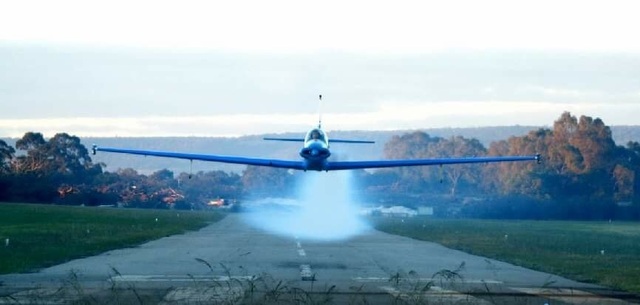
This is with one spray nozzle, but using citronella oil. As you can see, the smoke evaporates too quickly to be of any use.
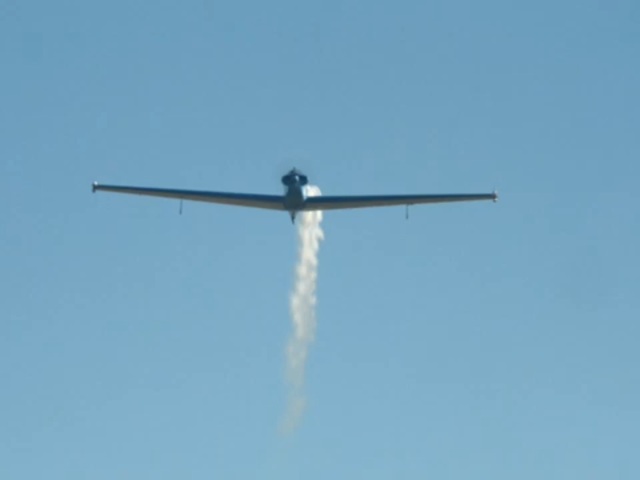
Now this is with two nozzles in the two left exhaust pipes, but using white oil again.
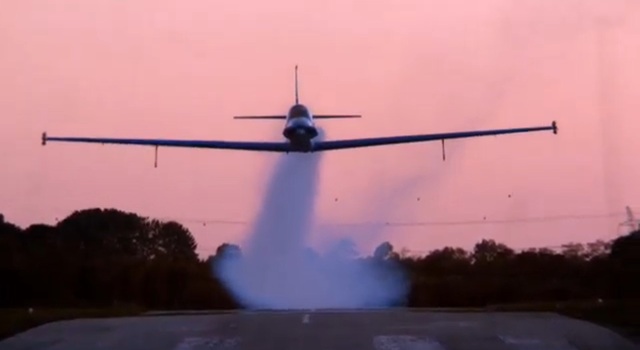
I am hoping to get this removable rig approved in Britain, so that anybody flying with a Volkswagen engine can use it.
More details to follow.
Happy Fournicating, Bob
[Edit by Bob Grimstead on Monday, July 13, 2020 @ 07:27 AM]
--------------------
|
SteveBeaver
Unregistered
|
Posted Tuesday, July 14, 2020 @ 01:13 PM
Is "Corvus" oil available in Perth? It would be interesting to compare.
|
Bob Grimstead
Unregistered
|
Posted Tuesday, July 14, 2020 @ 08:27 PM
I have never heard of Corvus oil Steve, either Britain or in Perth.
British display pilots generally use Shell's Ondina — a purpose designed smoke oil which I am told it is benign enough to drink although you wouldn't catch me doing that.
But you can't get Ondina here. We are right at the very end of all supply lines.
Kyle Franklin has this list of recommended smoke oils, and white oil is at the top.
A major export from Western Australia is wine and there are also growers of other fruits here so white oil is available. I just can't yet get it in the right quantities.
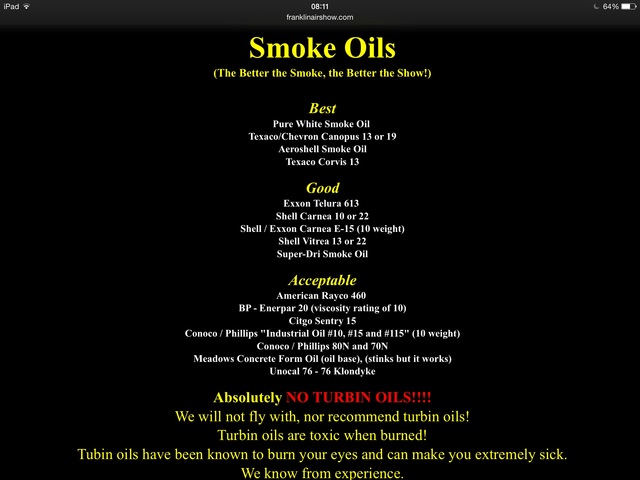
I'll ask around for Corvus oil and Canopus oil, but I doubt if they are available. Nevertheless, thanks for the tip Steve.
[Edit by Bob Grimstead on Tuesday, July 14, 2020 @ 08:28 PM]
--------------------
|
Bob Grimstead
Unregistered
|
Posted Tuesday, July 14, 2020 @ 08:34 PM
I won't use diesel despite its low cost, because it's such awful stuff.
And the brother of a display pilot who is also a good friend died horribly and in great pain after just once inhaling the smoke of turbine oil, so there is no way I would use that.
Citronella oil would be my preferred choice if I could find it in sufficient density that the smoke doesn't disperse quickly as it did in my experiment. It is a natural plant oil (derived from grasses) and smells good. Folk use it to deter flying insects, so I guess it can't be too bad for our health.
Anyway, the reasearch is interesting and the testing is fun, so both will continue as weather permits.
Results will be posted here.
Happy Fournicating everybody, Bob
[Edit by Bob Grimstead on Tuesday, July 14, 2020 @ 08:37 PM]
--------------------
|
SteveBeaver
Unregistered
|
Posted Tuesday, July 14, 2020 @ 09:48 PM
Kyle lists is as "Texaco Corvis" - I misspelled it 
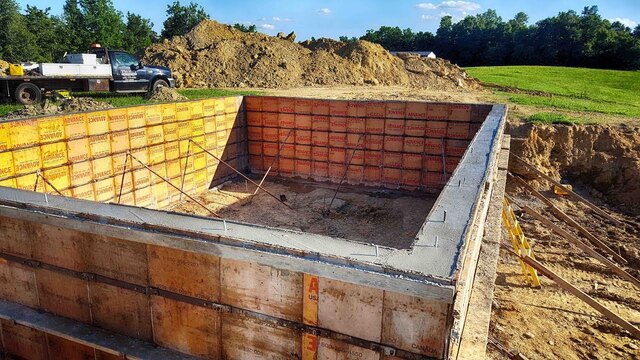
It is sold here as "Concrete form oil" and is used as a release agent on the wooden moulds used to pour concrete foundations. It only comes in 55 gal drums here as far as I know, but I live in an area with a lot of house construction going on and I can generally scrounge a small quantity when needed.
I like the sound of "white oil" though, and if it is just as good that is great.
|
Bob Grimstead
Unregistered
|
Posted Monday, July 20, 2020 @ 03:13 AM
So here's the full story, illustrated as I go...
I'm currently on an extended stay in Australia (thanks to COVID-19) so, as ever, trying to give myself some challenges, I've been devising a centre-line, engine, smoke system for my RF4D.
A primary design parameter was that it should not cost anything, or at least, as little as possible.
I searched YouTube for 'airplane smoke system' clips and found some useful parameters, which included:
Nozzle size & shape, pump capacity and oil tank volume.
My eventual component list read: Smoke oil tank, various types of preferably flexible tubing, an on/off valve, filter, pump, check valve, possible pre-heat system, wiring, fuse, switch, hydraulic connectors and electrical terminals.
So I searched all my bins containing old, used, discarded and scrap parts to come up with the simple system you see at the top of this page.
That baby oil was too little, too viscous and too expensive, so I bought half a litre (two pints) of this 'insecticide oil' which is commonly referred to as 'white oil', Google it and you find it's a light mineral oil the same as 'liquid paraffin' and several other things.
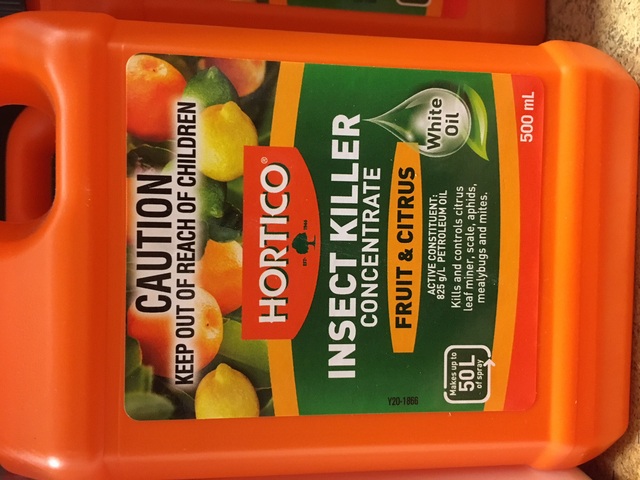
The container the oil came in became my 'tank', after drilling a hole in its cap for the pick-up and installing a bulkhead fitting. I then drilled four tiny 1/16" holes to allow air in. That's fine while I'm flying erect, but they will eventually be replaced with a one-way valve in a bigger, more permanent container.
Two short pieces of flexible rubber auto fuel line joined that small 'tank' to an in-line filter. After the filter came the pump, then another short piece of rubber fuel line to connect with a two-foot length of stainless wire-braided flexible tubing (sorry, but I have no idea where that came from).
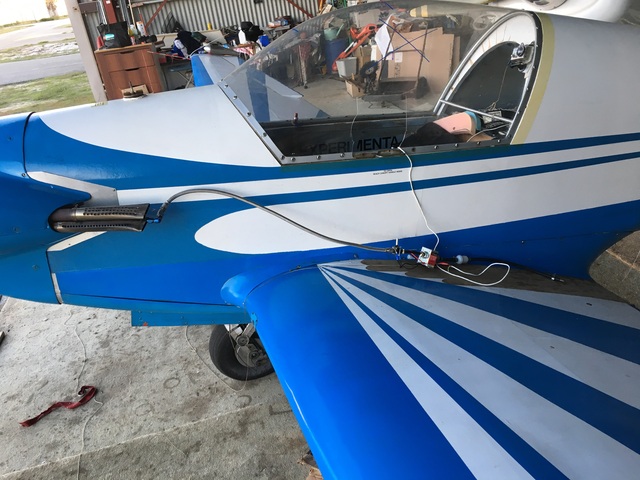
That in turn connected via a 45-degree fitting to an eighteen-inch length of quarter-inch, rigid stainless steel pipe (this may once have been a Lycoming pipe between constant-speed unit and prop governor). It already had a ninety-degree bend at the end, so I shortened that to less than an inch and crimped the end with side-cutters to make small dual nozzles (as suggested in one of those clips).
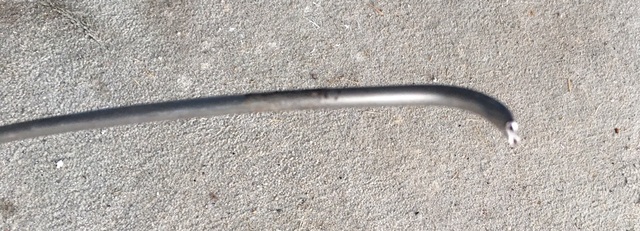
The idea was to push that long, rigid pipe into the lower (front) exhaust pipe so that my dual flow nozzle was as close to exhaust port as possible without being so close that the oil burned instead of smoking. Because of the lower exhaust's U-bend shape, that pipe will nicely jam in there without working loose or falling out due to vibration.
The wiring was dead simple. A length of twin-core wire, with an in-line fuse and an on-off two-pole switch.
The oil container goes by my side in the cockpit, with the filter, pump and switch ahead of it, and then the braided flexible line goes out of the DV window. I used braided or armoured line because all of that part will be at least slightly heated in the exhaust flow.
Here you see the whole thing in place beside the aeroplane.
--------------------
|
Bob Grimstead
Unregistered
|
Posted Monday, July 20, 2020 @ 03:59 AM
I bought my Facet pump for another project many years ago, but they currently cost around $40 and can deliver 0.5 USG or 2 litres per minute, which is about four times what I need (I hope).
Here is a still from a test run to see how the oil came out of my nozzles.
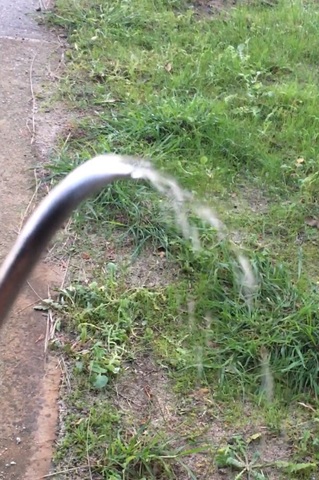
I stress that this is an initial, prototype system.
The idea is for it to be portable, and useable in any Volkswagen aeroplane with individual exhausts (RF3,4,7, Turbulent, VP-1/2, Taylor Monoplane, etc).
The eventual result, if successful, will have the oil container strapped down beside my seat (so the varying oil quantity doesn't affect the Center of Gravity), with the pump & filter screwed to a removable fitting on the sidewall, held in place by the locked canopy and with the tubing going out through the canopy's DV window.
Have fun experimenting by copying my rig if you wish.
A significant point to consider is the improved anti-collision safety this system imparts. When you see other traffic, or if somebody transmits that they can't see you, a brief puff of smoke makes you far more noticeable.
--------------------
|
Bob Grimstead
Unregistered
|
Posted Thursday, July 30, 2020 @ 03:49 AM
This is the set-up — so far, but I think further modifications are unlikely.
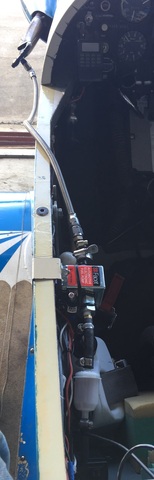
It is intended to be temporary and quickly removable to swap from aeroplane to aeroplane or for flight without it.
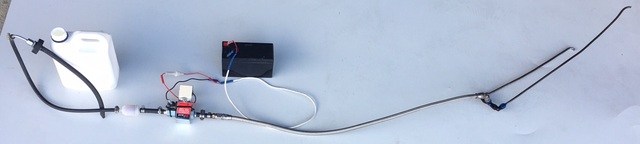
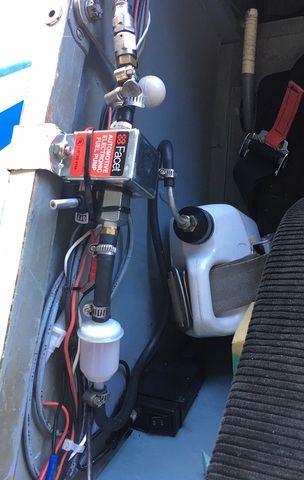
From left to right: oil bottle with cap containing bulkhead fitting, flop tube down into the bottle and external pipe going to... filter and pump.
The pump is bolted to a bracket that fits on the left sidewall and is clamped into place by the closed canopy.
From the pump is the wire to the switch and battery, with a removable fuse. For safety, I remove the fuse until the canopy is closed.
The hose clamp ahead of the pump has a 'butterfly' or wing-nut type for quick and easy tightening & loosening.
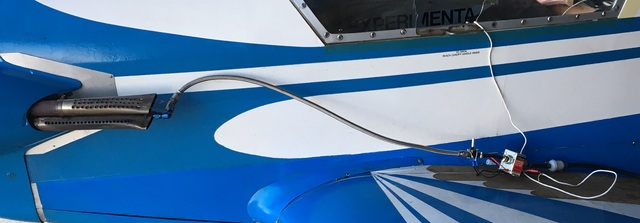
Forward of this everything is outside. The twin steel pipes with flared ends go into the two left exhaust pipes.
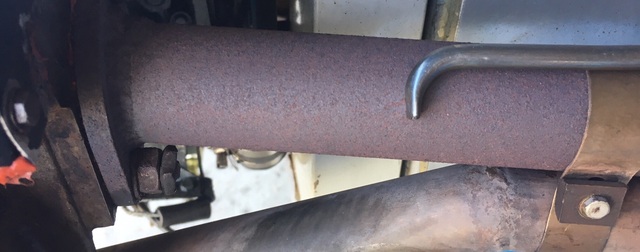
The upper one goes no closer to the exhaust flange than 10cm.
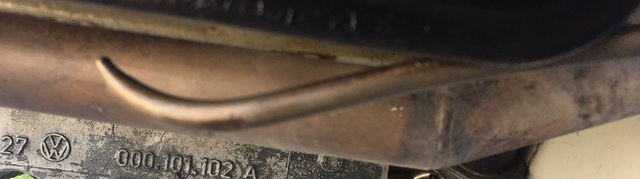
The lower one goes as far forward as it will go.
They do jam firmly in place, but it's easy enough to secure them with a twist of locking wire.
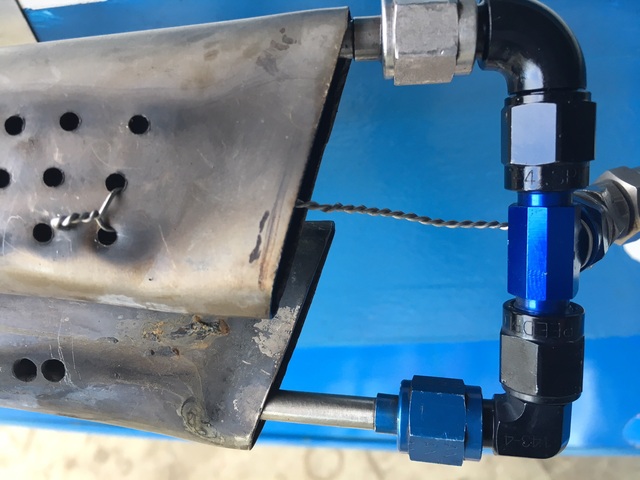
The whole rig, including wiring, and filled with oil weighs 1.1 kg and its weight is symmetrically disposed around the normal C of G, making the balance change zero.
I have a choice of two-, three- or four-litre containers. The same cap fits all three.
The heaviest, four litre container filled with oil weighs 3.2kg
The two litre container filled with oil weighs 1.8kg
The oil bottle goes beside my seat, effectively increasing the pilot's weight from 75kg to 77kg and keeping the C of G normal.
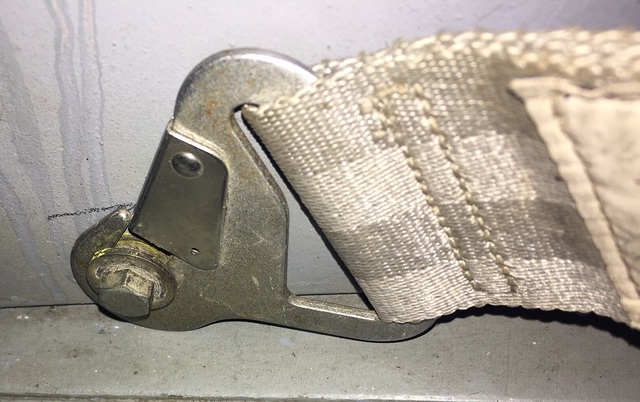
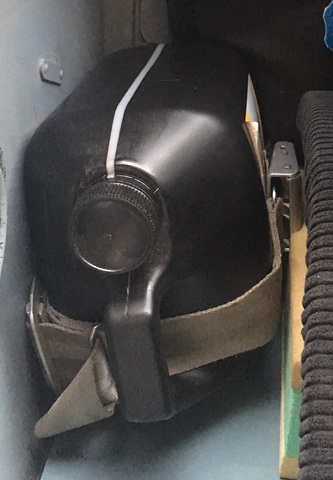
I bolted half of an aircraft seat belt to the lower rear cockpit side longerons where there are two glued together, making the total 15mm wide and 30mm high. I used a 5mm bolt, spacer & washers, and then clipped the adjustable outboard half of the belt to that.
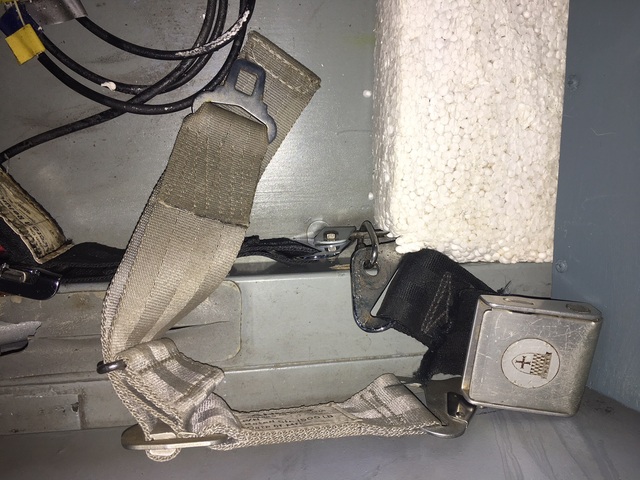
The inboard half is attached to my left seat belt fitting with a simple O-fitting. With adjustment, the belt will hold a two-three-or four-litre plastic oil bottle.
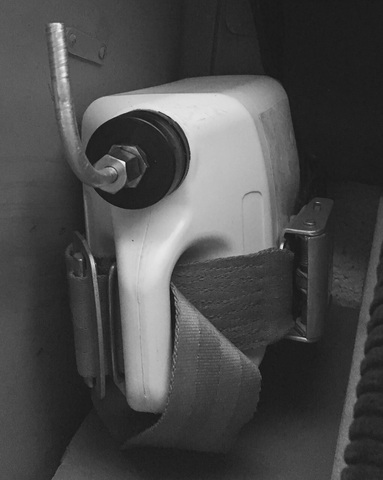
I have flown -2.5g aerobatics with the full four-litre bottle, proving the assembly's strength and security.
[Edit by Bob Grimstead on Thursday, July 30, 2020 @ 03:54 AM]
--------------------
|
Bob Grimstead
Unregistered
|
Posted Thursday, July 30, 2020 @ 04:21 AM
At first I didn't have any means of allowing air into the oil bottle when the oil was pumped out. I wanted to see what would happen.
What happened was that the botttle very sweetly collapsed in on itself.
Right now I can't find a small one-way valve. A bike tyre Schrader valve might work, but the ones I have need quite a lot of pressure to activate them.
The perfect valve would be the Stromberg CD150 needle valve, which I have on my aerobatic fuel cap. I do have a spare, but that is in England right now, and I'm not.
I'm sure you will understand the importance to me that that this system costs nothing, so I drilled the tiniest, near-invisible hole in the highest part of the bottle's handle. The drill bit was the smallest I have, a hair's-breadth. I've just come back from a five-minute, +5/-1.5g aerobatics session and there has been no leakage, neither has the plastic bottle collapsed. Obviously the smoke pump was running throughout, so the air being sucked in through this tiny hole nicely prevented any oil seeping out.
Obviously, the 0.7 litres of just two cylinders of a 1.4-litre Volkswagen engine are never going to produce the smoke of an Extra's nine-litre O-540 or a T-6's 22-litre R-1340, but it does make a visible smoke trail, and the current set-up burns a bit less than 1.5 litres of oil in four minutes. The water-miscible agricultural spray ('white') oil I'm using costs $3.85 per litre, so that's about five dollars for my sequence's smoke, as opposed to the $600+ the eight wingtip smokes cost.
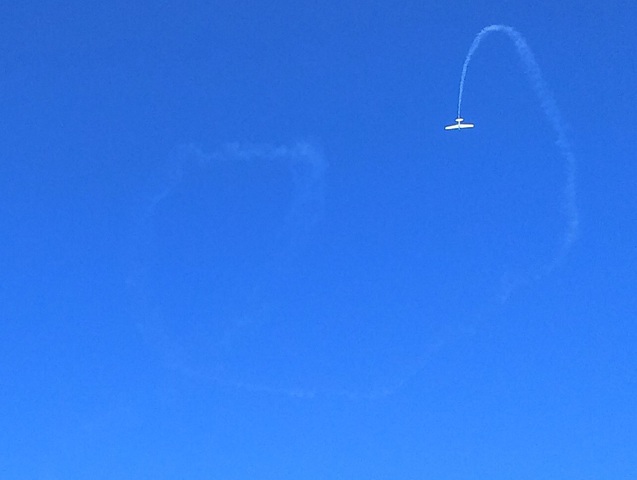
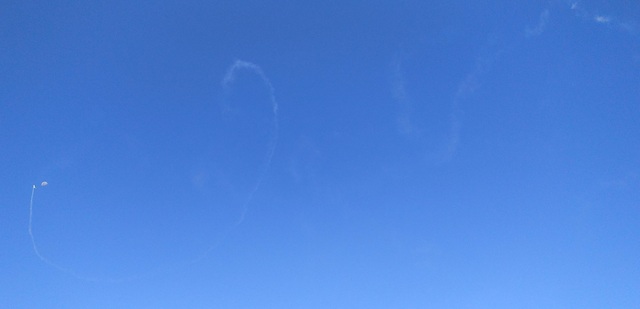
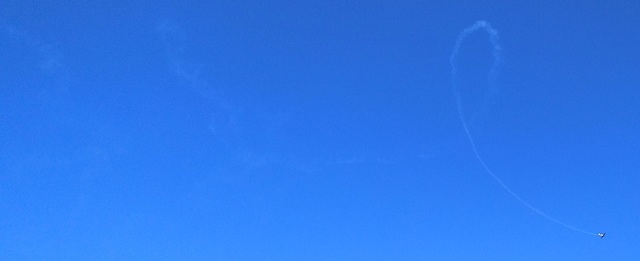
I am delighted to report that I am getting very little residue on the fuselage or tail after flight, and because this oil is miscible, it washes off easily, even without detergent.
You are all welcome to copy and use this system and as always, I would be very grateful for any comments or suggestions. I'll answer queries if I can.
My only caution would be to inspect the exhaust flanges before and after every flight because there is obviously a very slight additional load on them from the (negligible) weight of the pipes.
Happy Fourncation, Bob
--------------------
|
Bob Grimstead
Unregistered
|
Posted Thursday, July 30, 2020 @ 05:51 AM
Okay, I have just flown a +5.2 G/-2 G sortie to empty my 2 litre smoke oil bottle.
That took more than eight minutes.
So I am burning about a quarter of a litre of smoke per minute.
The white, citrus spraying oil I am using costs $3.85 per litre, so that means my smoke is costing much less than one dollar per minute.
Associated findings, which I would never have known without my smoke system:
My straight-and-level rolls are neither straight nor level.
I need to pause for longer before rolling (or roll more slowly) on the half-Cuban downline.
I need to hold forward stick for longer in the recovery from the flick roll in my avalanche.
And a chap can make himself feel quite giddy after eight minutes of continuous aerobatics!
[Edit by Bob Grimstead on Friday, July 31, 2020 @ 03:07 AM]
--------------------
|
Bob Grimstead
Unregistered
|
Posted Friday, July 31, 2020 @ 08:44 AM
Here's a low resolution clip of yesterday's test flight.
https://youtu.be/vBDgwi2x7jY
--------------------
|
Bob Grimstead
Unregistered
|
Posted Tuesday, August 4, 2020 @ 05:00 AM
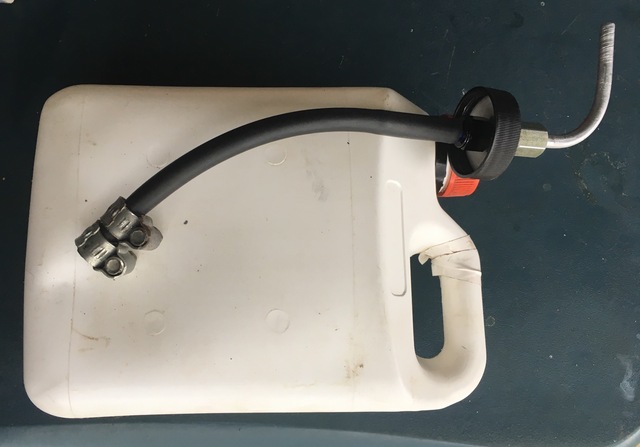
Having watched that clip, my good friend Bob Hart pointed out that the intermittency of the smoke is probably because I didn't have a flop-tube in my oil bottle.
So I have devised an extremely sophisticated flop-tube for my oil bottle.
--------------------
|
Bob Grimstead
Unregistered
|
Posted Monday, August 10, 2020 @ 03:53 AM
Now, with that flop-tube operational and the bottle on its side as illustrated above, I use rather more oil per minute because the smoke runs continuously... result!
I'll try to post better pics or a clip, maybe next weekend.
Anybody out there with a Fournier or any Volkswagen engine is welcome to copy my system.
Have fun, Bob
[Edit by Bob Grimstead on Monday, August 10, 2020 @ 03:54 AM]
--------------------
|
Bob Grimstead
Unregistered
|
Posted Thursday, August 13, 2020 @ 02:12 AM
I've been researching the flashpoints and autoignition temperatures of potential smoke oils to ensure I don't, like that famous French aviateur, 'go down in flames'.
This is what I've got. Flashpoint is the first number and autoignition temp the second one (if I can find it).
I think I shall use any non-flammable mineral or vegetable oil with a flash point of greater than 50°C and an autoignition temperature of greater than 210°C, such as:
White oil >150° >230°
Canola oil 327°C 424°C
Ondina Smoke Oil 180°C >320°C
Corvus 13 oil 150°C
Canopus 13 smoke oil 177°C
Liquid paraffin 112°C >165°C
Diesel >52°C >210°C
Transmission Fluid >150°C >210°C
Brake Fluid >100°C >280°C
Lubrication oil >150°C >260°C
Kerosene >38°C >210°C
Biodiesel 130°C
The top group obviously contains my preferred oils.
So far, the following seem to mix without coagulating: white oils & transmission fluid & lubricating oil & citronella oil.
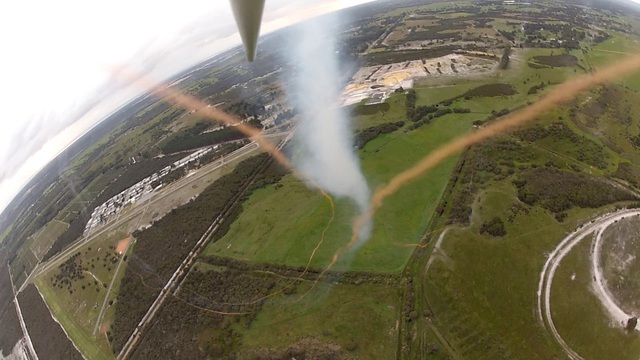
Here's a still taken from a clip from my rearward facing GoPro yesterday. The smoke is not tremendously dense, but it is just about good enough to show that my 'slow' (straight-and-level) rolls are certainly slow, but nothing like straight or level...
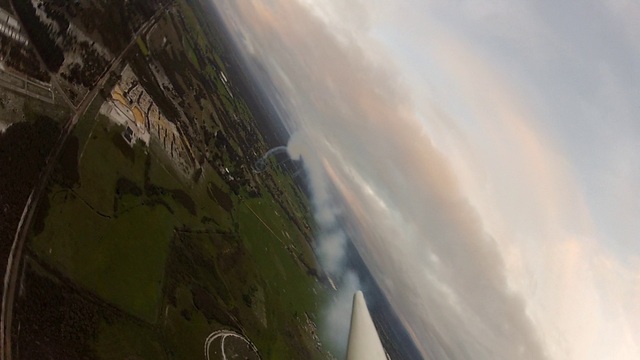
The white triangle at the bottom is of course my rudder.
Happy Fournicating, Bob
--------------------
|
Bob Grimstead
Unregistered
|
Posted Sunday, August 23, 2020 @ 10:18 AM
You may remember that I elected not to make a hole for the air to enter my smoke oil bottle and replace the oil that was pumped out because I didn't want any leaks in the cockpit.
But this is the result after seven minutes of smoking aeros. I thought it might amuse you all.
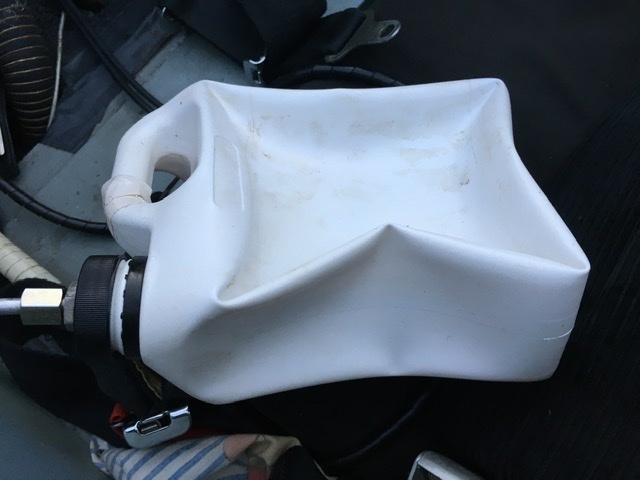
I've clearly got to use a bigger bottle!
[Edit by Bob Grimstead on Sunday, August 23, 2020 @ 10:31 AM]
--------------------
|
Donald
Unregistered
|
Posted Sunday, August 23, 2020 @ 03:58 PM
Come, come Bob. A man of your ingenuity should be able to devise a simple one-way pressure relief valve into that bottle. You might just be old enough to remember the sort of thing that was used for bicycle tyre (tire) valves back in the 1950s & 60s. A small bore tube, I'm thinking model shop supply here, open at the outer end, closed off at the inner end, a hole drilled across from side to side and a snug rubber sleeve, maybe heat-shrink, over the whole thing. Hot melt glue to secure it into a hole in the bottle cap.
|
Bob Grimstead
Unregistered
|
Posted Monday, August 24, 2020 @ 08:45 AM
I do have a low-pressure schrader valve from an old, perished bike tyre that I could use Donald, but almost no part of the upper edge of that oil bottle is thick, flat or rigid enough to be sure it won't leak. I get enough drops and dribbles of oil in the cockpit as things are.
So, instead, I'm going to try using a bigger, three-litre oil bottle with a bit of air space above the oil, to see how that works. I need to do that anyway because the bracket on the horizontal securing belt is too big to go through the two-litre bottle's handle, although it does go through the three-litre bottle's handle.
Continued experimentation should result in a satisfactory outcome, but meanwhile here's a clip of my smoke during a take-off.
https://youtu.be/PZjDVLhD1s0
--------------------
|
Bob Grimstead
Unregistered
|
Posted Tuesday, September 8, 2020 @ 08:41 PM
Hiya Fellow Fournicators,
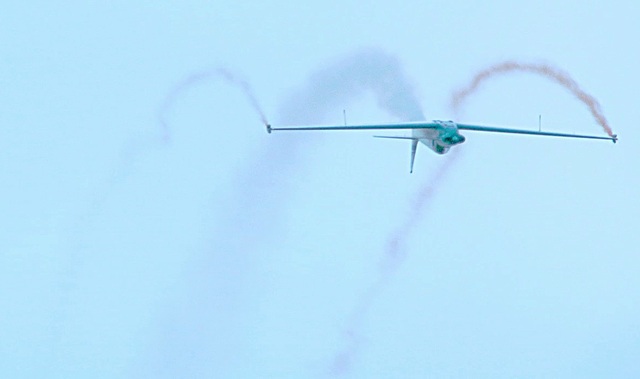
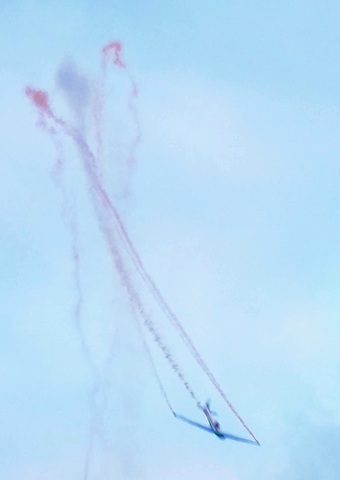
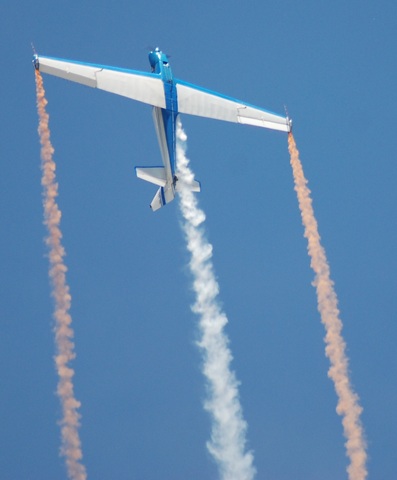
Now that I have triple smoke trails, I think my little RF4D paints better patterns across the sky.
What do you think?
--------------------
|
sericson
Unregistered
|
Posted Thursday, September 10, 2020 @ 06:24 PM
Looks great!
--------------------
|
Bob Grimstead
Unregistered
|
Posted Sunday, October 11, 2020 @ 02:46 AM
So, to try to prevent the oil container collapsing as the oil was pumped out of it, I tried tapping additional holes in two of my caps, tapping threads and fitting bike schrader valves.
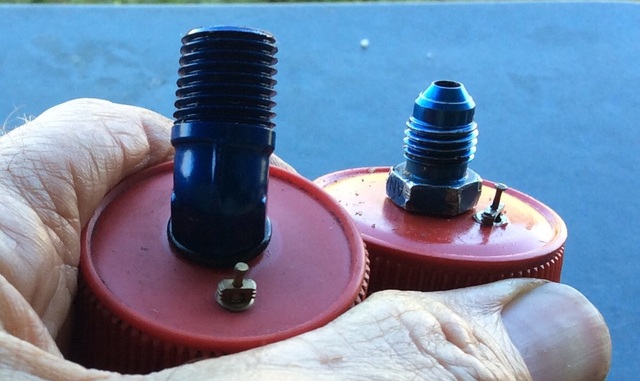
Unfortunately the oil container still collapsed, presumably because the required pressure to get air through the valve into the container is greater than the suction generated by the little pump I'm using, so I've discarded those caps and just accept that the container will collapse. One day it will split, but I have plenty of them so that's no problem.
--------------------
|
Bob Grimstead
Unregistered
|
Posted Tuesday, October 20, 2020 @ 00:08 AM
I have drilled a few more tiny holes (0.8mm) near the nozzles of the smoke tubes.
This has resulted in an improved smoke density, I think.
https://youtu.be/-d7pUBb3E5I
I still have to improve the flop tube so that I don't get so much intermittency as the oil quantity diminishes.
Cheers, Bob
--------------------
|
Donald
Unregistered
|
Posted Tuesday, October 20, 2020 @ 05:15 AM
Out of interest Bob, I know there is a photo further up this thread but what is your flop tube made of?
(re. your video, and I'm not criticising you or the cameraman, but isn't autofocus a damn nuisance!)
|
Bob Grimstead
Unregistered
|
Posted Tuesday, October 20, 2020 @ 08:56 AM
It's just a bit of floppy rubber tubing I happened to have lying about Donald — just like pretty well every other component.
Why do you ask?
Yes, autofocus is a pain. When I'm videographing aeroplanes I set the focus to 'manual' and 'infinity', but my mate Darren took this with his Samsung android phone, which presumably doesn't have that option. I didn't even know he was filming it until a couple of days later.
--------------------
|
Bob Grimstead
Unregistered
|
Posted Sunday, October 25, 2020 @ 10:01 PM
Well, I think I'm happy with that!
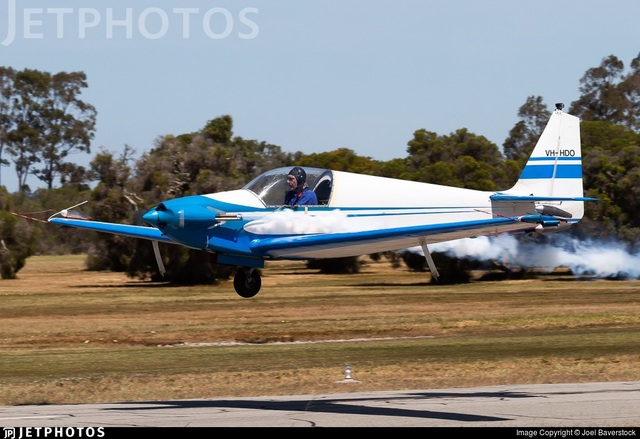
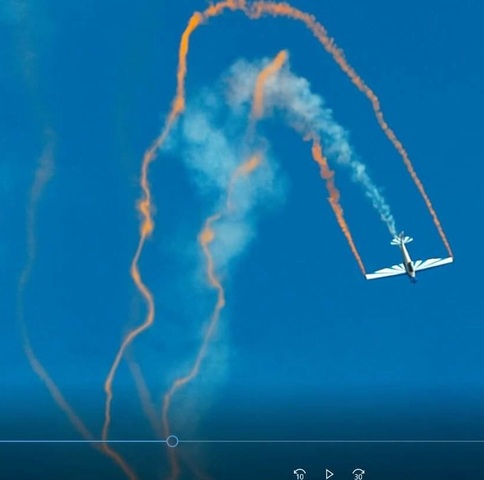
https://www.youtube.com/watch?v=8WxP5JEMC78
[Edit by Bob Grimstead on Monday, October 26, 2020 @ 05:22 AM]
--------------------
|
Bob Grimstead
Unregistered
|
Posted Friday, November 13, 2020 @ 11:01 PM
I think I've more-or-less achieved what I set out to achieve... three smoke trails of similar density:
--------------------
|
|

