New Forum
THIS FORUM IS NOW CLOSED/REPLACED DUE TO LACK OF TECHNICAL SUPPORT. YOU MAY STILL BROWSE AND READ POSTS, BUT YOU MAY NOT POST OR REPLY. YOUR CURRENT PASSWORD SHOULD WORK ON THE NEW SITE.

Please visit the new forum at New Fournier Forum

Important notice
Please remember that people from all over the world read and post on this forum, and that every country has its own rules, regulations and standards. This forum is based in the USA and so much of the information posted here is for the benefit of people who operate aircraft in the experimental/exhibition or experimental/racing categories. Advice given on this forum may be region specific. A person from Europe, for example, may make suggestions perfectly appropriate for a U.S reader, although not acceptable in his home country!

Please take this into account and carefully consult the authorities, standards and approved documentation where you fly.
Fournier Forums Upload picture | User Cp  |  Register  |  Members  |  Search  |  Help
    |- Fournier Aircraft > Aerobatics Post New Topic   Post A Reply
A nice avalanche dissected printer friendly version
next newest post | next oldest post
Author Messages
Bob Grimstead
Unregistered

Posted Saturday, April 18, 2020 @ 06:06 AM  


Hiya Fellow Fournicators,

While staying indoors for fear of catching this virus, I’ve been keeping my mind occupied with aviation by reviewing video footage of my last display practice.
For no apparent reason, the final avalanche in my sequence went more crisply than I think any avalanche has before, although I cannot see any reason for that on either the cockpit-cam or fin-cam footage. It also seems very nearly symmetrically aligned with the top of its loop, which is normally difficult to achieve given the 65-knot maximum allowable speed for kicking the rudder.
As a reminder, an avalanche is a loop with a flick (snap) roll at its apex.

This is it: https://youtu.be/sthVckgm4v8

As I say in the notes, It appears elongated horizontally because I had to play the clip on a wide screen TV and then record it with my iPhone because I cannot currently find a way of directly downloading the footage from the old Sony camcorder I was given (without instructions) by my late mate Alan Washington.

Anyhow, feeling that this was the best avalanche I’ve flown, and given that I still have a few tufts left on my wings, I thought I would investigate the fin-cam footage for clues.
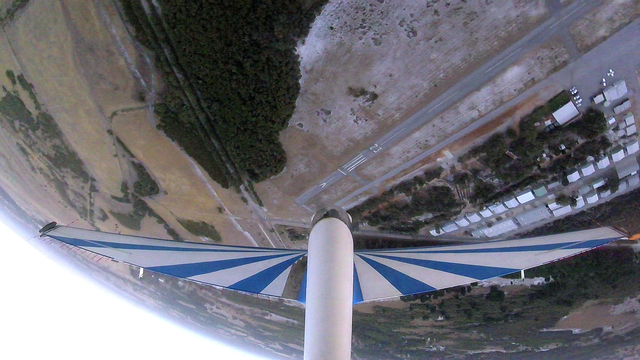
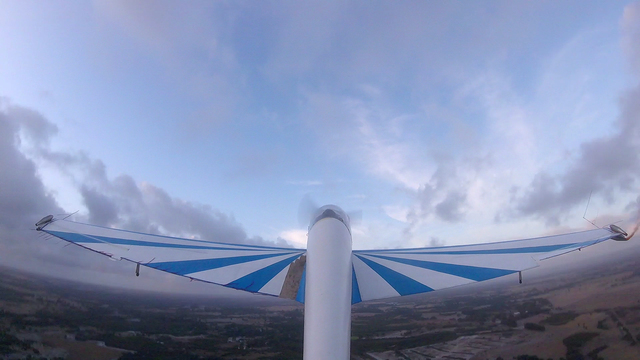
Nine stills follow from that footage.

In this first one the aeroplane has already rotated nearly eighty degrees from initiation of the flick roll. All the earlier frames were just too dark for me to make out what was happening with the tufts, but here it is quite clear and the right wingtip’s smoke makes it even more clear. The right wing is completely stalled, with an angle of attack at the rear of the smoke pod of about 45 degrees, while at the front of my wingtip sight it is nearer 75 degrees.
Ignore the 45-degree line just ahead of my smoke pod. That is my 45-degree wing-tip sight for establishing 45-degree up- and down-lines when I fly open-canopy.

What I find particularly interesting is that, judging by the directions of its trailing-edge tufts, the left wing also seems to be completely stalled out as far as the inboard end of the aileron, although the airflow seems to be at around sixty degrees to the span, and almost pointing along my sunburst stripes, suggesting a lot of slip (or is it skid?) is taking place .

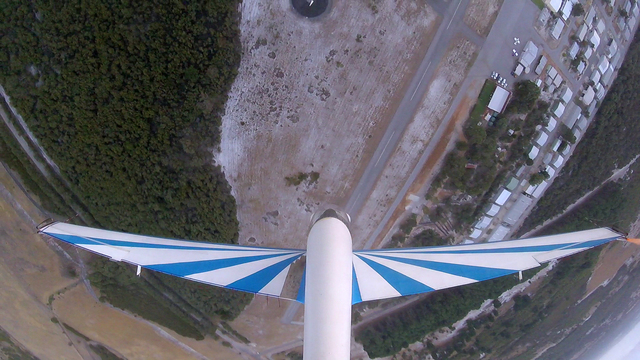
In the second picture the right wing’s AoA is even higher: about 85 degrees at the front of the sight although perhaps a little less at the smoke outlet. The left trailing-edge tufts are now streaming forwards more, but still at about 45 degrees to the trailing edge.
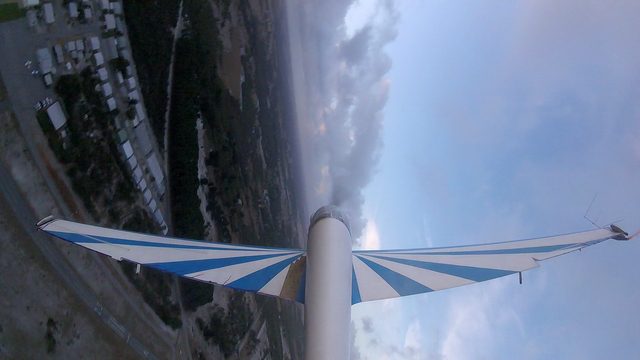
Looking at the third picture, the right wing-tip is now clearly travelling downwards through the air.
But looks at what’s happening over on the left wing (which should theoretically still be flying). Every single one of the tufts is streaming forwards in one way or another, although the flow is still generally towards the root inboard.
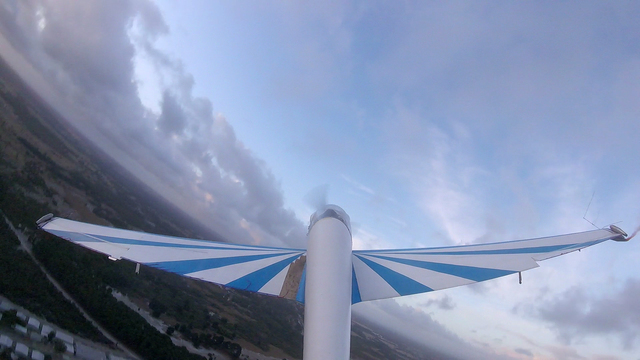
The fourth picture shows me virtually upright, and therefore a few degrees past half-way through the flick-roll.
The right wing is still completely stalled, as you would expect, with approximately a ninety-degree AoA, but now the airflow immediately aft of the left outer aileron is flying nicely – but only the outer half of it. The airflow behind the inner half of the left aileron is still chaotic, and along most of the inner left wing it is clearly flowing forwards.
--------------------

Bob Grimstead
Unregistered

Posted Saturday, April 18, 2020 @ 06:09 AM  

In the fifth photo I am almost three-quarters the way through the flick-roll, although I still have full in-flick controls applied (full aft stick, full right rudder and full right aileron).
Airflow over the whole of the right wing is still fully stalled, but the left wing’s airflow is starting to re-attach from the tip inwards. About the outer third of the left wing now seems to be flying normally.

Now I’ve removed the pro-flick controls to recover: full left rudder, full forward stick and ailerons centralised. Of course the throttle remains wide open throughout.
Airflow is almost fully re-attached, but of course the yawing/rolling momentum will carry the aeroplane through almost another ninety degrees yet.

Both wings are now fully flying and I’m just waiting for that full left rudder to oppose the rolling moment of inertia. Experience as well as normal practice tell me that applying left aileron at this stage only prolongs the flick roll by increasing the right wing’s AoA beyond the stalling angle again. Inadvertently having left aileron here can cause the flick roll to continue for another 180 degrees and even bite into a fully-fledged power-on spin.

Almost done:

Flick roll complete, so now I simply finish the loop. I am not aligned with the runway because I have a strong left-to-right (on-crowd) wind, so I have to lay off maybe twenty degrees of drift to fly parallel with the runway. Yes, the wind sock says the surface wind is straight along the runway, and it is, but it’s within ten minutes of sunset, so up here at 500 feet I’m flying in the geostrophic wind, plus we’re in the Southern Hemisphere, so the wind backs and increases with height.

I hope you found that of some interest.

Happy Fournicating, Bob

--------------------

Donald
Unregistered

Posted Saturday, April 18, 2020 @ 07:37 AM  

Hi Bob, I thought you might be along here soon.
I cannot comment knowledgeably about aerobatics so I won't but having watched your video several times this morning your post here answers something that was slightly bugging me.
I did not pick up from the video that you had one of your smoke pods going, possibly near the end of it's burn, so had wondered if the faint visible trail might have been your engine burning oil.
Evidently not, though.
SteveBeaver
Unregistered

Posted Saturday, April 18, 2020 @ 09:00 AM  

Very interesting Bob. Thanks for posting!
Bob Grimstead
Unregistered

Posted Saturday, April 18, 2020 @ 10:13 AM  

Thanks Chaps,

You will occasionally see a fine central trail of oil or oil smoke when I'm pushing negative G, but otherwise it's the marine distress smokes in my wingtip pods that form my smoke trail. Sadly they are not really dense enough and they only burn for a guaranteed three minutes nowadays. They used to be guaranteed for four minutes and usually lasted for five, but like all things in the 21st Century, the 'new, improved' version is shite!

In this case I was lucky, one of the eight smokes in my pods kept burning for just over five minutes.
If I could establish why and do something about it I would have dense smoke for longer, so watch this space.

Stay healthy everybody, Bob

--------------------

Bob Grimstead
Unregistered

Posted Saturday, April 18, 2020 @ 10:15 AM  

This is the footage from which those stills were taken, but reduced in clarity by the wonderful machinations of Windows Movie maker:
https://youtu.be/41rFO4WbGCM

And here is the same avalanche, seen from within the cockpit, but again degraded by Windows:
https://youtu.be/8UZUjc_18eg

[Edit by Bob Grimstead on Sunday, April 19, 2020 @ 03:19 AM]

--------------------

Collin
Unregistered

Posted Tuesday, April 21, 2020 @ 03:23 PM  

You make it look easy.

--------------------

Bob Grimstead
Unregistered

Posted Tuesday, April 21, 2020 @ 08:52 PM  

Thank you very much Collin,

It's fairly straightforward for me now, but it has taken me seventeen years to get to this point.

I must say that, having watched David Perrin fly graceful Fournier avalanched in the early seventies it has been my ambition to fly them ever since.

--------------------

Post New Topic   Post A Reply Jump to:
Contact Us | cfiamerica.com | Privacy Policy All times are GMT -4 Hours.
Welcome to The Fournier Forum, Guest!  
Login
Username :
Password :
In order to fully utilize the abilities of this board, you are required to register as a member. Registration is free, and allows you to do lots of things including turning on or off certain features of this board. Register now!
Forum Rules & Description
Who Can Read The Forum? Any registered user or guest
Who Can Post New Topics? Any administrator or moderator
Who Can Post Replies? Any administrator or moderator
Who Can Edit Posts? Any original author
It can never be said too often: Get professional instruction before you even read this section!
Currently Active Users: 427
There are currently 0 members and 427 guests on the boards. | Most users ever online was 42535 on 04-07-2026 02:43 AM
Search This Forum
Search Keywords: Search From:
Powered by CuteCast v2.0 BETA 2
Copyright © 2001-2003 ArtsCore Studios