New Forum
THIS FORUM IS NOW CLOSED/REPLACED DUE TO LACK OF TECHNICAL SUPPORT. YOU MAY STILL BROWSE AND READ POSTS, BUT YOU MAY NOT POST OR REPLY. YOUR CURRENT PASSWORD SHOULD WORK ON THE NEW SITE.

Please visit the new forum at New Fournier Forum

Important notice
Please remember that people from all over the world read and post on this forum, and that every country has its own rules, regulations and standards. This forum is based in the USA and so much of the information posted here is for the benefit of people who operate aircraft in the experimental/exhibition or experimental/racing categories. Advice given on this forum may be region specific. A person from Europe, for example, may make suggestions perfectly appropriate for a U.S reader, although not acceptable in his home country!

Please take this into account and carefully consult the authorities, standards and approved documentation where you fly.
Fournier Forums Upload picture | User Cp  |  Register  |  Members  |  Search  |  Help
    |- Fournier Aircraft > Propellers Post New Topic   Post A Reply
Prop lost inflight printer friendly version
next newest post | next oldest post
Author Messages
Bob Brock
Unregistered

Posted Sunday, March 12, 2023 @ 11:17 PM  

Just after takeoff a couple of months ago, at about 200' AGL, and beyond the end of the runway, the wood prop, spinner, crush plate departed the engine of the L-13SE Vivat two place motor glider. I was giving the new owner his self launch endorsement. Snap, the prop was gone! The RPM started to increase and I immediately pulled the power to idle, lowered the nose in a turn for a reverse field landing. I had over 400 hrs in this aircraft and never thought to remover the spinner and check the prop bolts. My understanding is that the six 7mm high strength prop bolts had been torqued to about 18 foot pounds and safety wired. The aircraft had recently gone through an annual inspection prior to the sale. The solid wood prop was built by Props Inc. in Newport, Oregon. It is also the company that built the wood prop I have on my RF-4d.

All six bolts sheared off next to the prop hub at the start of the threaded section. The removed treaded part of the bolts were removed from the propeller hub. Our IA, Robin Reed, had seen this type of problem when working on 100HP formula racing aircraft at the Reno Air Races. Even slight movement of the wood prop created heat and metal fatigue in the prop bolts.

Collen told me that our wood props should be checked for proper bolt torque several times a season. This could have been a catastrophic failure and accident, but it was just another uneventful low return and reverse field landing. I always include at least one for a Flight Review since most glider pilots rarely do them except for the Practical Glider test to obtain their license.

Sorry if I don't get the pictures the right size, but here they are:


Donald
Unregistered

Posted Monday, March 13, 2023 @ 08:26 AM  

Interesting tale, Bob, but one with a good outcome. Well done.

Like Collin I have always understood that with wooden props, which can expand and contract with the change of season, they should be loosened and re-torqued three or four times a year to compensate.

But it's interesting too about your torque value of 18 foot pounds for a 7mm bolt.
My RF3 is a different animal to a Vivat and my prop is a Hoffmann, a wooden prop but again a different animal to one from Props Inc.
My prop bolts are 8mm and until a few years ago I had always used a torque value of 24.5 N/m, equivalent to 18 foot pounds, as stated in the old L-666 based flight manual. From slight crushing visible on the prop hub I'd often thought that too much, but who was I to counter the flight manual?

However with the Hoffmann the data plate on the prop itself states that for 8mm bolts the torque value should be from 15 - 17 N/m, that's equivalent to 11 - 12.5 foot pounds! That data plate has these values for different sizes of bolts:-
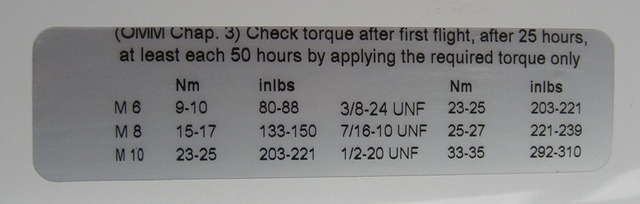
I'd have kinda expected that torque for 7mm bolts would lie somewhere between that for 6mm and 8mm but then again I've always assumed that with a wooden prop the concern would be crushing of the prop hub, not the tensile strength of the bolt, so probably my expectation is meaningless. So I'm not saying you should do this, just that the torque value of 18 foot pounds seems high to me. Does your prop hub show any evidence of crushing?

In my own case the step down from 24.5 to 15 N/m, -40%, was huge! (When first fitted I used the lower value of 15N/m on the basis that the new prop would have come from a climate controlled condition at manufacture to my climatically very variable hangar in Scotland where expansion would be likely.) That worked fine and I've never varied it. My Hoffmann has suffered no crushing of the hub nor departure in flight so I take it Hoffmann know what they are about. Does Props Inc state what the torque value should be?

[Edit by Donald on Monday, March 13, 2023 @ 08:33 AM]

Donald
Unregistered

Posted Monday, March 13, 2023 @ 11:15 AM  

Mulling this over I have revisited your first photo and have a question. On the Vivat is it the prop bolts which transmit the torque to the propeller?
Again going back to my RF3 the bolts just hold the prop in place but they screw through the prop, front to back and into, I don't know what might be the proper name for them, but a 'top hat' sort of thing. The 'brim' being on the back side of the prop boss with the 'top' sticking out through the front to engage with a counterbore in the back of the prop to transmit the torque. Does that make sense?
I'm not seeing anything like that from your photos but if your bolts ARE transmitting the torque then your arrangement is quite different to mine and my comments are without value.
Fredrik S
Unregistered

Posted Tuesday, March 14, 2023 @ 04:55 AM  

I'm not sure what propeller INC says in their manual or how the rules are for TMG:s in the states but in the EASA world in europe and in every propeller manual i have come across you are supposed to remove the propeller during the annual inspection in order to inspect the propeller hub for cracks wich in turn means that you also inspect the bolts, holes for the bolts in the propeller, re-tourque the bolts and check the tracking of the prop to be within specs at least once a year.

I know it's in the manual for MT-propellers, Hoffman propellers used to have it and i think it's stated in the manual for our hercules propeller on our RF4.

I have until now not heard of a propeller departing from the engine like it did for you Bob but i am very glad that everything went ok .

As a flight instructor i am curious to know how the area around your airfield looks like, in Europe (at least in Sweden) we teach to not do a 180 in case of emergency below 300 feet AGL if anything happens during take-off, if you are below 300 we teach our students to land straight ahead at the best possible location in the direction of the runway +-10 to 15 degrees.
I guess that the american instructons may differ and that it may depend on how the location looks?

--------------------

Post New Topic   Post A Reply Jump to:
Contact Us | cfiamerica.com | Privacy Policy All times are GMT -4 Hours.
Welcome to The Fournier Forum, Guest!  
Login
Username :
Password :
In order to fully utilize the abilities of this board, you are required to register as a member. Registration is free, and allows you to do lots of things including turning on or off certain features of this board. Register now!
Forum Rules & Description
Who Can Read The Forum? Any registered user or guest
Who Can Post New Topics? Any administrator or moderator
Who Can Post Replies? Any administrator or moderator
Who Can Edit Posts? Any original author
Propellers for motorgliders
Currently Active Users: 242
There are currently 0 members and 242 guests on the boards. | Most users ever online was 42535 on 04-07-2026 02:43 AM
Search This Forum
Search Keywords: Search From:
Powered by CuteCast v2.0 BETA 2
Copyright © 2001-2003 ArtsCore Studios